How to Scale LinkedIn Outreach: The Account Math Nobody Explains (2026)
Doubling your LinkedIn pipeline is not about sending more from one profile. It is about adding sending identities. Here is the real math behind scaling LinkedIn outreach, the tools that survive it, and the account layer that sets your true ceiling.
Almost everyone tries to scale LinkedIn outreach the wrong way. They find a message that works, then they send more of it from the same profile. More connection requests, more InMails, more follow ups, all piled onto one account. It works for a week. Then the invites stop landing, the warning banners show up, and the account that was carrying your pipeline goes quiet or gets restricted.
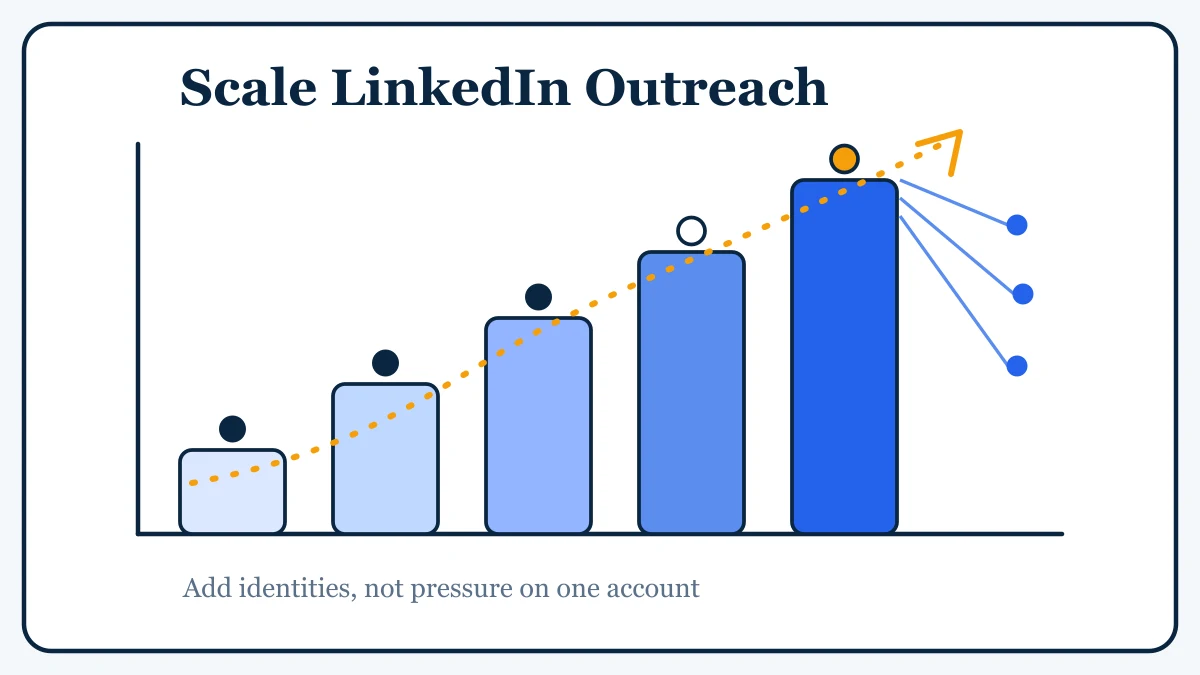
The mistake is treating volume as something you extract from a single identity. LinkedIn does not work that way, and it never has. Scaling outreach is really an exercise in adding identities, not squeezing the ones you have. Once you understand the math behind that, the whole problem changes shape and gets a lot easier to plan.
The Hard Ceiling on a Single Account
Every LinkedIn account has a practical output ceiling, and it is lower than most people want it to be. A safe, healthy account sends somewhere around 20 to 25 connection requests a day, plus a modest number of messages and InMails on top. Push past that consistently and you are trading short term volume for a long term restriction. We laid out the real numbers in our guide to LinkedIn connection request limits.
Here is what that ceiling means in practice. Call it roughly 100 to 125 new conversations started per account per week at a safe pace. If your reply rate is decent, that is a real but capped amount of pipeline. The important word is capped. You cannot buy your way past it on one profile, because the limit is not about effort or spend, it is about how much a single human identity can plausibly do before the platform decides it is not human.
So the question stops being “how do I get more out of this account” and becomes “how many accounts do I need to hit my number.” That reframing is the entire game.
The Scaling Math, Made Concrete
Work backward from a pipeline target instead of forward from activity. Say you want 40 qualified conversations a week and, being honest, you convert about 8 percent of new connections into a real conversation. That means you need roughly 500 new connections a week. At a safe 100 to 125 per account, that is four to five sending identities, not one profile working five times as hard.
This is why operators who scale cleanly think in fleets, not heroics. Doubling output means doubling identities and keeping each one at a calm, human pace. It never means doubling the load on accounts you already have. Our post on how many LinkedIn accounts you can run for outreach walks through the safe multiplication in more detail, but the headline is simple: capacity is a function of how many identities you run, not how hard you run each one.
That single shift, from pressure to breadth, is what keeps a scaled operation stable. Every account stays inside safe limits, keeps looking human, and the aggregate output climbs because there are simply more of them.
The Two Layers You Are Actually Scaling
Scaling LinkedIn outreach means getting two separate decisions right at the same time: the tool you automate with, and the account you run it on. Teams that nail one and ignore the other burn accounts either way.
Layer one: the automation tool
Most LinkedIn tools were built for one person automating their own profile, and they quietly fall apart at fleet scale. The dividing line that matters is whether the tool supports custom dedicated proxies, because that is the only way to give each identity its own clean, stable IP instead of dumping them all onto shared infrastructure.
Tools that support custom proxies, and therefore actually work when you run rented or avatar accounts at scale, include Expandi, HeyReach, Skylead, We-Connect, Buzz, and LIA. HeyReach in particular was designed to manage many sending accounts under one roof, which is exactly the shape scaled outreach takes.
Tools that do not support custom proxies, and therefore force your accounts onto shared IPs, include Dripify, Waalaxy, Zopto, Dux-Soup, and Ulinc. They can be fine for a single hobbyist profile, but at scale they take away the one control signal you most need. We compared the whole field in our top 10 LinkedIn automation tools to scale your outreach, and went deeper on the proxy split in our guide to automation tools that work with rented accounts.
Layer two: the accounts you send from
This is the layer that sets your real ceiling, and it is the one most teams underinvest in. You have four options for where your extra identities come from, and only one of them scales without a fight:
- Your own real profile, cloned harder. This is the trap we started with. There is only one of you, and one ceiling. It does not scale, it just breaks.
- Bought or aged accounts. You inherit an unknown history and no support when one gets restricted. We compared this path in AIA avatars or aged LinkedIn accounts, which is better.
- Rented human accounts. Workable, but you depend on someone else’s login and behavior, and you cannot provision more on demand. See renting LinkedIn accounts for outreach.
- Purpose built avatar accounts. Pre warmed, ID verifiable identities built to be automated, each ready to attach to its own proxy. Going from five to fifty is a configuration change, not a sourcing hunt.
The reason avatars win for scale is provisioning. Human profiles have to be sourced one at a time, and price and quality wobble as supply tightens. Avatars are created and warmed on demand, so your fleet size becomes a decision instead of a scavenger hunt. This is where AIA sits, with avatars that arrive pre warmed, pre aged, and already carrying 100 or more connections so they can start sending without the fragile ramp a brand new account needs.
What Breaks at Scale, and How to Prevent It
Anyone can run one account. The failures show up when you go from a handful of identities to dozens, and they are predictable enough to plan around.
- Restrictions become a numbers game. Run enough accounts long enough and one will eventually trip a limit. That is not a crisis if a warmed replacement is ready in days. AIA commits to a 48 hour replacement SLA, so a restricted avatar is a fixed problem rather than a stalled campaign. Ask any provider you shortlist for their replacement terms in writing.
- Shared infrastructure flags accounts in clusters. If your identities share IPs or fingerprints, one aggressive account raises risk for all of them. A dedicated proxy per identity is the single biggest technical difference between fleets that scale and fleets that get flagged. Our guide on protecting your LinkedIn account from restriction covers the per account behavior that keeps this stable.
- Warm up time becomes a bottleneck. If every new account needs three weeks of babysitting before it sends, scaling stalls. Pre warmed accounts skip that. If you do want to warm your own, here is how to warm up a new LinkedIn account for outreach.
None of this makes LinkedIn risk free. It never is, and any provider who promises zero risk is not being honest with you. What a proper account layer does is turn platform risk from an existential threat into a predictable line item, priced and planned for in advance.
Scale Past LinkedIn Alone
The best scaling move most teams miss is refusing to be trapped on one channel. A single outreach identity can run LinkedIn, email, and X in parallel, which multiplies touches per prospect without adding a single new person to your team. AIA pairs its LinkedIn avatars with pre warmed email avatars at $11 per domain, so the same persona can reach a prospect on more than one channel from a coordinated identity rather than three disconnected tools. When you are already running a fleet, adding a channel per identity is often a bigger lever than adding more identities.
Pricing That Scales With You
Scaling only works if the account layer is priced to grow with your volume. AIA avatars run $147 (Gold, ID verified), $197 (Titanium, ID verified), $97 (Silver), and $177 (Platinum) per profile per month, with ID verified options on the Gold and Titanium tiers for higher trust campaigns. Volume discounts of 10, 20, and 30 percent kick in at 10, 50, and 100 or more avatars, so your per account cost drops exactly as your fleet grows. Full numbers are on the AIA pricing page.
For a sense of what a correctly built account layer unlocks, one top 100 US agency ran 185 AIA avatars to over 500 SQLs and $2.3M in net new revenue in under 90 days. That result did not come from clever copy alone. It came from having enough trusted, warmed identities to run real volume at a safe per account pace.
The Scaling Playbook, Step by Step
- Set a pipeline target and work backward. Decide how many conversations a week you need, apply your real conversion rate, and calculate the number of connections, then the number of accounts, required to hit it.
- Pick a proxy compatible tool. Choose from the custom proxy list above based on your channel mix and team size. HeyReach and Expandi are strong scaling starting points.
- Provision a pre warmed avatar fleet. Order AIA avatars sized to the account count your math produced, not the count you wish you needed.
- Assign a dedicated proxy per identity. One stable, persona matched IP per account, never shared across the fleet.
- Keep every account at a human pace. Spread volume across identities rather than piling it onto any single account, and stay inside safe connection request limits.
- Scale by adding identities. To grow output, add avatars, do not push existing accounts harder. Capacity climbs with account count, and every identity stays safe.
The Bottom Line
Scaling LinkedIn outreach is not a copywriting problem and it is not a willpower problem. It is an account math problem. One profile has a hard ceiling, so real scale comes from running more trusted identities at a calm, human pace, on a tool that respects proxies, on top of a pre warmed account layer that grows on demand. Get that stack right and hitting a bigger number stops being a gamble and becomes a provisioning decision.
Build the Fleet Your Pipeline Actually Needs
Your outreach can only scale as far as your account layer lets it. Run pre warmed, ID verifiable AIA avatars built for volume, each ready to attach to your tool and its own proxy, backed by a 48 hour replacement SLA and volume discounts that reward you for growing. Start your order at app.getaia.io, or message the AIA team on WhatsApp if you want help sizing a fleet to your pipeline target first.