LinkedIn Outreach for Consulting Firms: How Agencies Book Meetings for Expertise-Led Sellers
Consulting buyers hire people, not pitches. How agencies run LinkedIn outreach for consulting firms: practice lanes, honest sender roles and a fast partner handover.
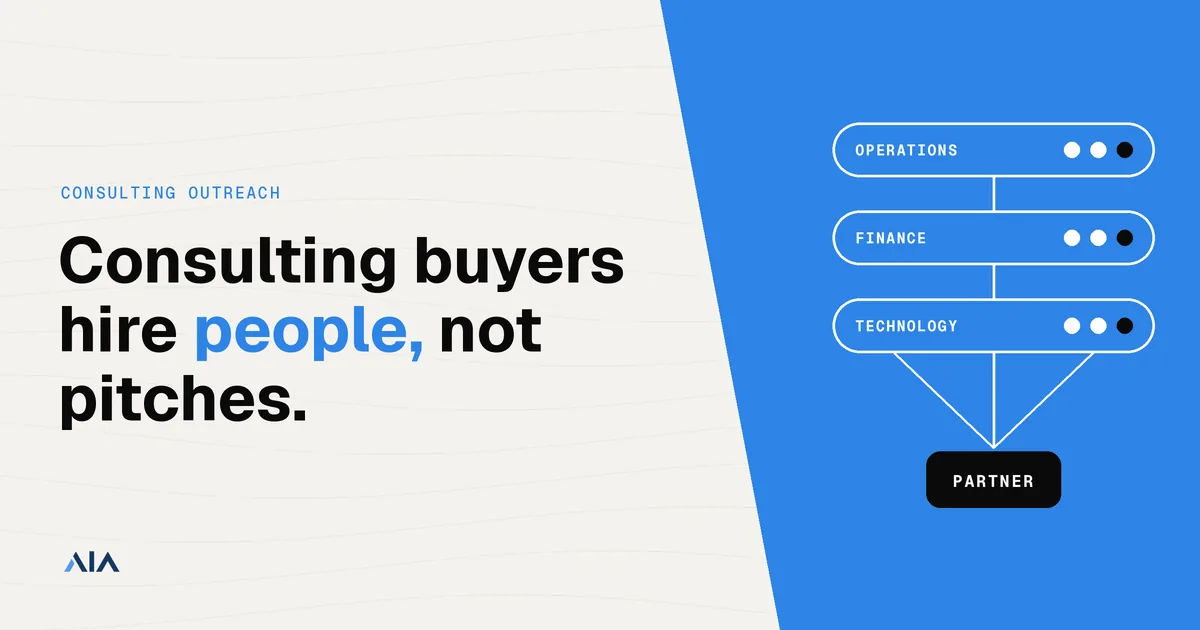
Consulting firms are some of the hardest clients an outreach agency can take on, and some of the most rewarding once the system works. The buyer is not choosing a product. They are choosing the people who will sit in their meetings for the next six months, and they usually check who those people are before they reply to anything.
That one fact breaks most generic LinkedIn playbooks. A volume-first campaign that works for a SaaS tool, sending the same three-line pitch to every operations director in a region, tends to produce polite silence for a consulting firm. The message reads like a vendor, the profile behind it is not the person the buyer would work with, and nobody explains why this firm has something worth thirty minutes.
This guide covers how agencies can run LinkedIn outreach for consulting clients without fighting that reality: who should send, how to split the market into practice lanes, what a first message from a consulting firm should actually say, how to hand warm replies to a partner quickly, and where the approach does not fit at all.
Why Consulting Is a Different Sale
Three things make consulting outreach different from most of what an agency runs.
The expertise is the product. A buyer cannot trial a strategy engagement or a transformation programme. They judge the firm on how well its people understand the problem, so the first few messages are effectively a sample of the work.
Buyers check people. Before a senior buyer agrees to a call, many will open the sender’s profile, look up the firm, and look for a partner whose background matches their problem. If what they find is thin or generic, the thread usually ends there.
Most new work still comes from relationships. Referrals, alumni networks and repeat clients tend to carry a consulting firm. Outbound is rarely the main engine. Its job is to reach the companies the partners do not already know, at the moment those companies have a problem the firm is good at.
So the goal is not “book as many meetings as possible”. It is “start credible conversations with the right seniority, and get them in front of the right partner fast”.
Decide Who Sends, and Be Honest About Their Role
Agencies usually have three kinds of sender available for a consulting client.
| Sender | Good for | Watch out for |
|---|---|---|
| A partner’s own profile | Warm threads, late-stage conversations, anything about scope or price | Limited time, and it should never carry cold volume |
| Firm employees’ profiles, with consent | Practice-specific outreach where the employee genuinely works on the topic | People leave, and the network leaves with them |
| Avatar profiles you control | Cold first touches across many lanes and segments | Buyers who check profiles, and the platform risk covered below |
The honest way to use avatar profiles for a consulting client is as business development, not as the consultant. Set the role and company sections to something like a business development or client partnerships role at the firm. Do not present the profile as the person who will run the engagement, and do not give it case studies or credentials it does not have. When the buyer asks something only a consultant can answer, the avatar’s job is to introduce the partner.
AIA lets you edit the headline, about section, current role and company, previous experience, skills, banner and featured section of each profile, which is enough to brief a clear business development persona per practice. The full list is in which sections of an AIA you can customise. The trade-offs between avatars and the firm’s own people are covered in rented LinkedIn profiles vs your own team’s profiles.
Split the Market Into Practice Lanes
A consulting firm rarely sells one thing. It has practices: operations, finance transformation, technology strategy, people and change, and so on. Each one sells to a different buyer for a different reason, so each deserves its own lane.
A lane is one practice, one buyer persona and one geography, run from its own sender profiles. For example, “supply chain advisory to heads of operations at mid-sized manufacturers in the DACH region” is a lane. “Everything we do, to every director in Europe” is not.
For each lane, agree four things with the client before anyone writes a message:
- The buyer. Title, seniority and company size. Consulting buyers are usually senior, so lists are smaller and every contact matters more.
- The trigger. What tends to happen right before a company needs this practice: a new leader in the seat, a merger or acquisition, a regulatory change, a failed system rollout, a cost programme announced in the press.
- The point of view. The one opinion the partners hold about this problem that the buyer may not have heard. This becomes the core of the message.
- The partner. Who takes the warm replies for this lane, and how fast they can respond.
The trigger list is what keeps consulting outreach relevant. A message tied to a recent change in the buyer’s world reads as timely. The same message sent to a static list reads as spam.
Write Messages That Sound Like the Firm Thinks
The most common mistake in consulting outreach is leading with credentials. “We are a boutique advisory firm with deep expertise in…” tells the buyer nothing they could not assume, and it is the opening every other firm uses.
Lead with the point of view instead. A useful structure for a first message after a connection is accepted:
- The observation. One sentence about something specific to the buyer’s situation, usually the trigger.
- The opinion. One or two sentences of what the partners see in similar situations, framed as a view, not a promise.
- The small ask. An offer that costs the buyer little: a short note on how other firms approach the problem, or a 20 minute conversation with the partner who leads the practice.
Keep connection notes short or skip them, and save the substance for after the accept. Pace and wording for later touches are covered in how to follow up on LinkedIn after no response.
Two rules matter more for consulting than for most clients. Never imply results the firm cannot back up, because senior buyers will ask for the example. And never have an avatar profile claim personal experience delivering projects. “Our operations partner has worked on several of these” is honest. “When I led a similar programme” is not.
Use a Slow Cadence
Consulting buyers move slowly, and a fast, pushy cadence signals the opposite of the judgement they are paying for. A sensible sequence for a lane:
- Connection request, with or without a short note.
- First message a few days after the accept, using the observation, opinion, small ask structure.
- One follow-up a week or two later that adds something new: a short point about the trigger, or a question about how they are approaching it.
- A final, low-pressure note that leaves the door open, then stop.
Stay inside sensible daily limits. AIA recommends no more than 20 connection requests per day per profile, and the reasons behind per-account limits are in LinkedIn connection request limits. Because consulting lists are small and senior, that pace rarely holds a campaign back.
Hand Warm Replies to a Partner Fast
This is where consulting campaigns are won or lost. A senior buyer who replies with a real question expects to talk to someone who can answer it. If the reply sits in an avatar inbox for three days, or gets a scheduling link and nothing else, the moment passes.
Agree the handover rules at kickoff:
- What counts as warm. A question about the problem, a request for more detail, or a yes to a call.
- Who takes it. The named partner for that lane, with a backup.
- How fast. Ideally the same working day.
- Where it moves. Usually to email or the partner’s own LinkedIn profile, with a short, honest introduction from the avatar: “I have asked our head of the operations practice to reply directly.”
Moving warm threads off the avatar profile early also protects the client. If a profile is ever restricted, the conversation already lives somewhere the firm controls. Multi-channel outreach from one LinkedIn identity covers how to keep the story consistent when a thread changes channel.
Report What a Consulting Client Cares About
Connection acceptances and message counts mean little to a managing partner. Report the funnel, but put the weight on the later stages:
- Conversations started with buyers at the agreed seniority
- Partner meetings held, not just booked
- Opportunities or proposals that came from those meetings
- What buyers said about the problem, in their own words
That last item is often the most valuable thing you send. A consulting firm can use what buyers say in replies to sharpen its point of view, which in turn improves the next round of messages. The reporting rhythm for the first month is covered in onboarding a LinkedIn outreach client.
What It Costs to Cover the Lanes
Consulting lanes are narrow, so most firms need fewer profiles than a volume client, but more care per profile. Count the lanes, decide how many senders each needs to cover its list at a conservative pace, and price from there.
AIA’s LinkedIn plans, cheapest first, from the pricing page: Silver at $97, Gold at $147, Platinum at $177 and Titanium at $197 per profile per month. For senior buyers who are likely to open the profile, the real-person Gold and Titanium tiers can be a closer fit than proprietary AI profiles, and the 500+ connection tiers give a profile more visible history. Sales Navigator is an add-on at $57 per profile per month, and what it changes on a rented account is explained in Sales Navigator on rented LinkedIn accounts.
Be Honest About Platform Risk
Renting or sharing LinkedIn accounts is outside LinkedIn’s User Agreement, and AIA’s own FAQ says AIA operates outside LinkedIn’s Terms of Use. Any profile can be restricted, including ID-backed ones. A consulting client should hear that in the kickoff, not after a restriction.
Keep each profile on its own infrastructure that you provide, such as your own proxy and browser setup, keep the partners’ profiles completely separate from the avatars, and move warm threads to channels the firm controls. Know the replacement terms before you start. For AIA, they are in what happens if AIAs get restricted.
Where This Playbook Does Not Fit
Some consulting clients should not run avatar-led outreach at all.
- Solo consultants and personal brands. When the consultant is the brand, outreach should come from their own profile, at a pace they can sustain.
- Regulated advice. Firms giving regulated financial, legal or audit advice may face professional rules on solicitation and how they describe themselves. They should check those rules before any outbound campaign, and avatars may simply not be appropriate.
- Public sector and formal procurement. Where work is won through tenders and frameworks, a LinkedIn conversation rarely changes the outcome.
- Firms with no point of view. If the partners cannot say what they believe about the buyer’s problem, more profiles will only spread a generic message further. Fix the message first.
Getting Started
Pick one practice with a clear buyer, a visible trigger and a partner who will answer replies quickly. Agree the point of view, brief two or three business development personas for that lane, and run the slow cadence for a month before adding a second practice. The setup guide walks through ordering and customising profiles.
Planning outreach for a consulting client? Message us on WhatsApp at wa.me/37256084933 with the practices, regions and buyer personas you have in mind, and we will suggest how many profiles and which tiers fit.
Ready to start the first practice lane? Visit app.getaia.io to place your order, or start with the AIA pricing page to plan your profiles.