How to Price LinkedIn Outreach Services: Retainer, Pay-Per-Meeting and Hybrid Models for Agencies
Retainer, pay-per-meeting or hybrid? How agencies can price LinkedIn outreach, treat the account layer as cost of goods, and keep margin as clients scale.
Most agencies set their LinkedIn outreach price by looking at what competitors charge and shaving a little off. That works until the first client asks why meetings dipped in month two, or until the agency realises half its margin went on profiles that had to be rebuilt mid-campaign.
A price that holds up starts somewhere else: with what it actually costs you to deliver a month of outreach, and with a clear agreement on what the client is paying for. This guide walks through the three pricing models agencies use for LinkedIn outreach, how to build the account layer into each one, and how to avoid the contract terms that quietly turn a good client into an unprofitable one.
Start With Your Cost to Deliver
Before you choose a model, write down what one client costs you per month. Every LinkedIn outreach engagement has the same four cost lines, whether or not your spreadsheet names them.
1. The account layer. The LinkedIn profiles that send the connection requests and messages. For most agencies this is the line that decides how many prospects a client can reach each month, because every profile has a safe daily pace and volume comes from running more of them.
2. The automation tool. The software that runs sequences on each profile. Most tools charge per sender, so this line grows with the account layer.
3. Data and list building. Lead lists, enrichment and the time spent cleaning them. This is small for some niches and large for others.
4. People time. Copywriting, campaign management, reply handling and reporting. For most agencies this is the biggest line, and it is the one that scales worst when campaigns are unstable.
Add the four together and you have your cost to deliver. Your price has to cover that number with room left for margin, for the month a client underperforms, and for the time you spend selling the next client. If you cannot fill in all four lines, you are not ready to quote yet.
The Three Pricing Models
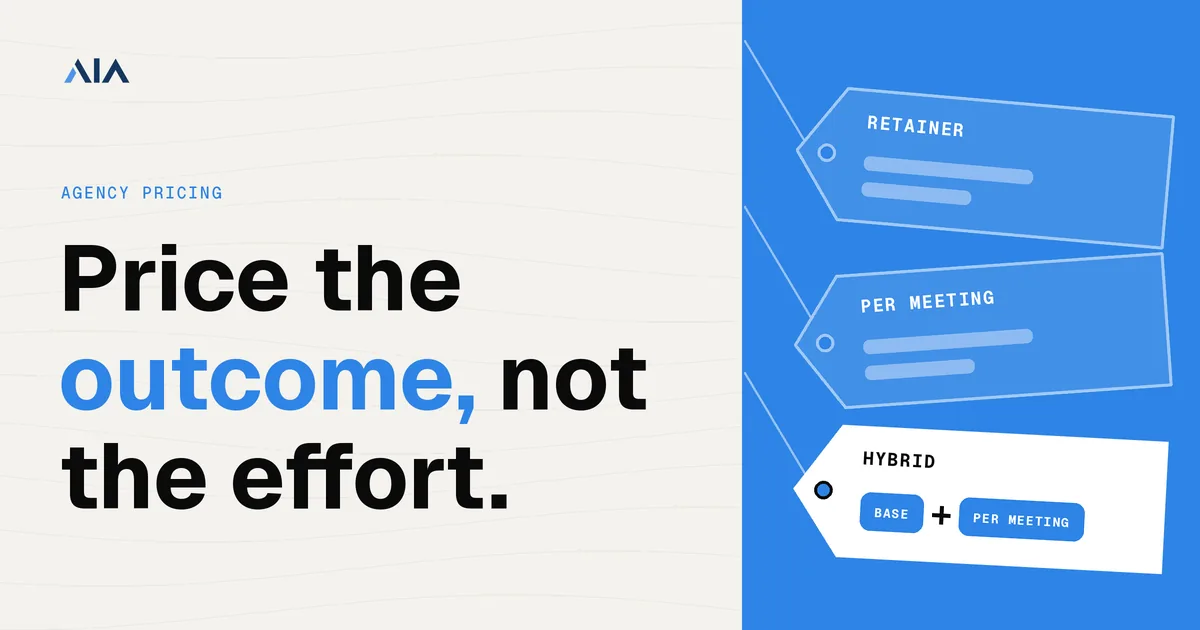
Almost every agency offer is a version of one of these three. Each one moves risk between you and the client in a different way.
Monthly Retainer
The client pays a fixed monthly fee for a defined scope: a number of profiles, a target audience, copy, campaign management and reporting.
A retainer is the easiest model to run. Your revenue is predictable, you can staff to it, and you are paid for the work whether a given month produces three meetings or thirty. The downside is that the client carries all the performance risk, so retainers are harder to sell to buyers who have been burned by an agency before. Expect more questions in the sales process and a stronger push for a short initial term.
Pay Per Meeting
The client pays only for qualified meetings that land on their calendar. No meetings, no invoice.
Pay per meeting is easy to sell, because the client sees no downside. It is also the riskiest model you can offer. You carry every cost from day one, including the weeks of warm-up before profiles reach full pace, and you are exposed to things you do not control: the client’s offer, their sales team’s follow-through and how strict they are about what counts as a meeting. Agencies that do well with it tend to have a narrow niche, proven copy for that niche, and a tight written definition of a qualified meeting.
Hybrid: Base Fee Plus Per-Meeting Fee
The client pays a smaller monthly base that covers your cost to deliver, plus a fee for each qualified meeting.
For most agencies this is the model that holds up best. The base fee means you are never paying to run a client’s campaign out of your own pocket, and the per-meeting fee gives the client a reason to trust that you care about outcomes. It also gives you a natural lever in negotiations: a client who wants a lower base can accept a higher per-meeting fee, and the other way round.
| Model | Who carries the risk | Easy to sell? | Revenue for you | Best fit |
|---|---|---|---|---|
| Monthly retainer | Mostly the client | Harder | Predictable | Clients who value process, longer engagements |
| Pay per meeting | Mostly the agency | Easy | Uneven | Narrow niche with proven copy and offer |
| Hybrid | Shared | Moderate | Predictable base plus upside | Most agencies, most clients |
How to Build the Account Layer Into Every Deal
The account layer is your cost of goods, and the agencies that struggle with pricing are usually the ones that treat it as an afterthought.
The simplest way to handle it is to know your per-profile cost and price in multiples of profiles. AIA lists each profile as a flat monthly figure on the pricing page: Silver at $97, Gold at $147, Platinum at $177 and Titanium at $197 per profile per month, with volume discounts once you run 10 or more profiles. That turns the account layer into a number you can quote against instead of a cost that moves every time a profile gets restricted.
Here is an illustrative example, not a benchmark. Say a client plan needs four profiles on the Gold tier. The account layer costs 4 x $147, which is $588 a month at list price. Add your automation tool per sender, your list costs and the hours your team spends on that client, and you have the floor for the base fee. Anything you charge above that floor is margin.
There are two ways to show this cost to clients:
- Bundled. The profiles sit inside your fee and the client never sees them as a separate line. This is cleaner for most clients and lets you choose the tier mix yourself.
- Pass-through. The profiles appear as their own line, billed at cost or with a small handling margin. This works well with procurement-heavy clients who want to see exactly what they are paying for, and it makes scaling up an easy conversation: more profiles, more reach, a clearly priced line.
Either way, decide in advance who pays when a client asks for more volume mid-month. Adding profiles is the fastest way to grow reach, so write the per-profile price for extra capacity into the proposal.
If you are still deciding which tier to run for a client, the trade-offs between AI-generated and real-person profiles are covered in AIA avatars or aged LinkedIn accounts, and the full cost picture at scale is in the real cost of LinkedIn outreach per meeting.
Define What Counts as a Meeting Before You Sign
If any part of your price depends on meetings, the definition of a meeting is the most important sentence in the contract. Most pricing disputes between agencies and clients come down to this sentence being vague.
A workable definition covers:
- Who. The prospect matches the agreed ideal customer profile: title, seniority, company size and region. Write it down and attach it to the contract.
- What. A scheduled call on the client’s calendar, accepted by the prospect, with enough context that the client knows why it is happening.
- No-shows. Decide whether a no-show counts, counts after one reschedule attempt, or never counts. Each is reasonable; leaving it open is not.
- Disputes. Give the client a short window to flag a meeting as unqualified, with a reason that refers back to the written profile. After the window closes, the meeting is billable.
- Existing pipeline. Exclude current customers and open opportunities at kickoff, so a meeting with someone already in the client’s CRM does not become an argument later.
This takes an hour to agree at the start and saves weeks of back and forth later.
Price the Ramp-Up, Do Not Absorb It
New profiles need time before they run at full pace. Lists need building, copy needs approval, and the first replies take a while to arrive. If your price assumes full output from day one, you are funding the first month yourself.
Three ways agencies handle this:
- A setup fee. A one-time charge that covers onboarding, list building, copy and profile setup. It also filters out clients who are not committed.
- A reduced first month. The base fee applies from day one, but per-meeting fees only start once campaigns are live.
- A minimum term. A short minimum gives campaigns time to reach steady output before anyone judges them.
Whatever you choose, tell the client how the first month will look. The client onboarding playbook lays out the first weeks step by step, and it is a useful thing to walk a prospect through before they sign.
Mistakes That Erode Agency Margin
The same few pricing mistakes show up again and again.
- Pricing on effort. Clients do not buy connection requests or messages sent. If your proposal lists activity volumes as the deliverable, you will be compared on cost per action, which is a race to the bottom.
- Buying the cheapest profiles to protect margin. Low-cost accounts that get restricted often cost more in rebuild time, lost volume and client trust than they saved. Price the account layer you actually need.
- One price for every niche. A list of busy enterprise buyers is harder and slower to work than a list of small business owners. Your per-meeting fee should reflect that.
- Unlimited revisions. Copy rounds, list changes and new segments all take people time. Include a set number per month and price extras.
- No volume ladder. If a client wants to double reach, you should already know what that costs and what you will charge. Volume discounts on the account layer only help your margin if your own price does not drop at the same rate.
When Pay-Per-Meeting Is the Wrong Model
Pay per meeting sounds client-friendly, but there are situations where it hurts both sides.
It works badly for very small or very senior markets, where there are only a few hundred possible buyers and every one of them needs careful, slow outreach. It works badly when the client’s offer is new and unproven, because you end up paying to test their positioning. And it works badly when the client’s team is slow to confirm meetings or does not follow up, because your revenue then depends on a sales process you cannot see.
In those cases, a retainer or a hybrid with a modest per-meeting fee is the honest offer. You can still tie part of your fee to outcomes, just not all of it.
A Simple Pricing Sheet to Start From
If you are building or rebuilding your offer, this structure covers most cases:
- Setup fee, one time, covering onboarding, lists, copy and profile setup.
- Monthly base, covering your cost to deliver for an agreed number of profiles and audiences.
- Per-meeting fee, for meetings that match the written definition, starting once campaigns are live.
- Extra capacity, priced per additional profile per month, so scaling up is a one-line change.
- Minimum term, long enough for campaigns to reach steady output.
Then check the numbers against your cost to deliver for one real client. If the base does not cover the four cost lines, the model is not finished. For the wider picture of building an agency around this, see how to start a LinkedIn lead generation agency and the white-label LinkedIn lead generation guide.
The Bottom Line
The right price for LinkedIn outreach is the one that covers your real cost to deliver, shares risk in a way the client can accept, and leaves you margin when a month goes badly. For most agencies that means a hybrid: a base fee that covers the account layer and your team, plus a per-meeting fee with a tight definition behind it. Get the cost side predictable first, and the pricing conversation with clients becomes much easier.
Want to size the account layer for a client proposal? Message us on WhatsApp at wa.me/37256084933 with the volume you are quoting, or go to app.getaia.io to order your profiles.