LinkedIn Follow-Up Message After No Response: Timing, Templates, and What Actually Works (2026)
Most LinkedIn replies come from the follow-up, not the first message. Here is how long to wait, how many times to follow up, and word-for-word templates that turn silence into conversations without being annoying.
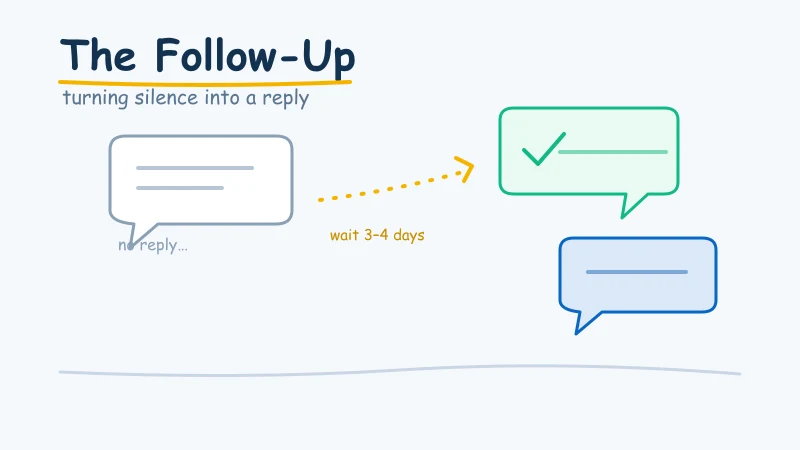
You sent a well-crafted LinkedIn message to a perfect-fit prospect. They accepted your connection. And then… nothing. No reply, no reaction, no clue whether they read it at all.
This is the most common moment in outbound, and it is also the most misunderstood. Most people treat silence as a rejection and move on. The teams that book the most meetings do the opposite: they follow up, deliberately and politely, because a large share of every reply they get comes from message two, three, or four rather than the opener.
This guide covers exactly how to follow up after no response on LinkedIn: how long to wait, how many times to try, what to say each time, and the mistakes that get you ignored or blocked. If you have already worked on your message reply rate, the follow-up is the single highest-leverage lever left.
Why the Follow-Up Matters More Than the Opener
Silence on LinkedIn almost never means “no.” Your prospect is busy. Your message arrived at a bad moment, got buried under notifications, or was read on a phone between meetings and quietly forgotten. None of that is a decision about you or your offer. It is just noise.
A short, respectful follow-up cuts through that noise. It reappears at the top of their inbox at a better moment, and it signals that you are a real person who genuinely wants a reply rather than a script that fires once and gives up. In practice, a meaningful chunk of positive responses arrive only after the first follow-up. Teams that stop at message one are, quite literally, leaving half their replies on the table.
The catch is that follow-ups have to be done well. Done badly, they read as needy or robotic and get you muted. Done well, they feel like a natural nudge from someone worth answering.
How Long Should You Wait Before Following Up?
The most common mistake is following up too fast. A “just bumping this up” message sent the next morning reads as impatient and makes you look like you have nothing better to do.
Here is a timing rhythm that respects the other person’s inbox:
- First follow-up: 3 to 4 days after the original message. Long enough that they have genuinely had time to see and forget it, short enough that the context is still fresh.
- Second follow-up: 5 to 7 days after the first. Give the previous nudge room to breathe.
- Third and final touch: 7 to 10 days later. This is your graceful exit, not another pitch.
Notice the gaps widen as you go. Escalating pressure gets you blocked; easing off keeps you welcome. Spacing your touches across one to three weeks also keeps your daily activity calm and natural, which matters for account health if you are sending at any volume. On that note, respecting sane connection request limits and overall message pacing protects the account doing the work.
How Many Times Should You Follow Up?
Three follow-ups after the original message is the sweet spot for cold LinkedIn outreach. That gives you four total touches, which is enough to catch people who were simply busy without tipping into harassment.
After the fourth touch with no reply at all, stop messaging and let it rest. A prospect who has ignored four thoughtful messages is telling you something, and pushing further only damages your reputation and your account. You can always re-engage months later with a genuinely new reason, such as a relevant post they wrote or a change at their company.
The goal is persistence with a hard ceiling, not an endless drip.
The Follow-Up Sequence: Templates That Work
Below is a full sequence you can adapt. Replace the brackets with real, specific detail. The single biggest predictor of a reply is that the message could only have been written to that one person.
Message 1: The original (for context)
Hi [Name] — I noticed [specific, genuine observation about their role, company, or a recent post]. We help [their type of company] with [outcome], and I thought it might be relevant to what you are working on. Worth a quick chat?
Follow-up 1 (3 to 4 days later): add value, do not nag
Do not just “bump” the thread. Give them a reason to reply that did not exist in message one.
Hi [Name], following up on my note above. I put together a short breakdown of how [similar company] handled [specific problem] — happy to send it over if useful, no strings. Would that be helpful?
Follow-up 2 (5 to 7 days later): make it easy to say no
Lowering the stakes paradoxically raises your reply rate. People answer honest, low-pressure questions.
Hi [Name], I know inboxes are brutal. If this is not a priority right now, totally fair — just let me know and I will get out of your way. If it is worth a look, I am happy to keep it to ten minutes.
Follow-up 3 (7 to 10 days later): the graceful close
The break-up message is often the highest-performing one in the whole sequence, because it triggers a last-chance response.
Hi [Name], I will stop here so I am not cluttering your inbox. If [outcome] ever becomes a priority, my door is open — feel free to reach out anytime. Wishing you a strong quarter either way.
That final message frequently pulls replies from people who meant to answer and never did. It works precisely because it removes all pressure.
Follow-Up Rules That Separate Replies From Blocks
The templates only work if the fundamentals underneath them are right.
- Never send a bare “bump” or “just checking in.” Every message must add something: a resource, a new angle, a genuine question. A nudge with no new value is what gets you muted.
- Keep each one shorter than the last. By follow-up three you should be at two or three sentences. Long messages read as pressure.
- Reference something real. “Saw your post on [topic]” beats any generic line, and it proves you are paying attention rather than running a blind sequence.
- Match your cadence to a human, not a machine. Identical messages fired at exact intervals look automated, and being obviously templated is a fast route to being ignored. Vary the wording and timing.
- Know when to quit. Four total touches, then stop. Restraint protects both your reputation and your account.
The Factor Nobody Talks About: The Account Doing the Following Up
Here is the uncomfortable part. You can nail your timing, write perfect templates, and personalise every line, and still watch your follow-ups underperform, because the account sending them is the hidden ceiling on the whole thing.
If you are running outreach at any real volume, the trust and health of the sending profile quietly shapes everything. A new, thin, or over-extended account gets less reach, lands in fewer inboxes, and is far more likely to be restricted or suspended mid-sequence — which kills your follow-ups before they are ever seen. A mature, warmed, trusted profile does the opposite: it delivers, it looks credible when the prospect clicks through, and it survives sustained activity. If you are scaling, the account math behind LinkedIn outreach matters as much as your copy.
This is exactly the problem AIA is built to solve. Instead of risking your own profile or juggling a pile of fragile accounts, AIA gives you established, warmed LinkedIn accounts and AI avatars engineered to send outreach — and follow-ups — at scale without the constant fear of a restriction wiping out your pipeline. Your sequences only pay off if the account behind them is trusted enough to keep sending, and that is the layer most teams ignore until it breaks.
Putting It All Together
A great LinkedIn follow-up is not about being persistent for its own sake. It is a small system: wait the right amount of time, add value each touch, keep it short, personalise relentlessly, and stop after four. Do that, and you will convert the silent majority of your prospects into conversations that the one-and-done crowd never even knows they missed.
Start with the timing rhythm, steal the templates above, and make sure the account doing the sending is healthy enough to carry the whole sequence. That combination — good copy on a trusted account — is what turns “no response” into a booked meeting. Ready to stop losing replies to a fragile account? See how AIA does it.