White-Label LinkedIn Lead Generation: How Agencies Scale Client Outreach Without Getting Accounts Restricted
White-label LinkedIn lead generation only works if you can run a separate, healthy fleet of sending accounts for every client you serve. Here is how agencies structure the account layer, price it, and keep it running without the restrictions that sink most reseller programs.
Selling LinkedIn lead generation as a service is a great business right up until the accounts start getting restricted. The pitch is easy: you promise clients a steady flow of booked meetings, you run the outreach for them under your own brand, and you keep the margin. The hard part is never the pitch or even the copy. It is the plumbing underneath, the actual LinkedIn accounts doing the sending. Get that layer wrong and your whole white-label program becomes a treadmill of banned profiles, angry clients, and refunds.
This guide is about that plumbing. If you run an agency and want to resell LinkedIn outreach at scale, the account layer is the part that decides whether you have a business or a liability. Here is how to structure it so you can take on client after client without the restrictions that quietly kill most reseller programs.
What White-Label LinkedIn Lead Generation Actually Requires
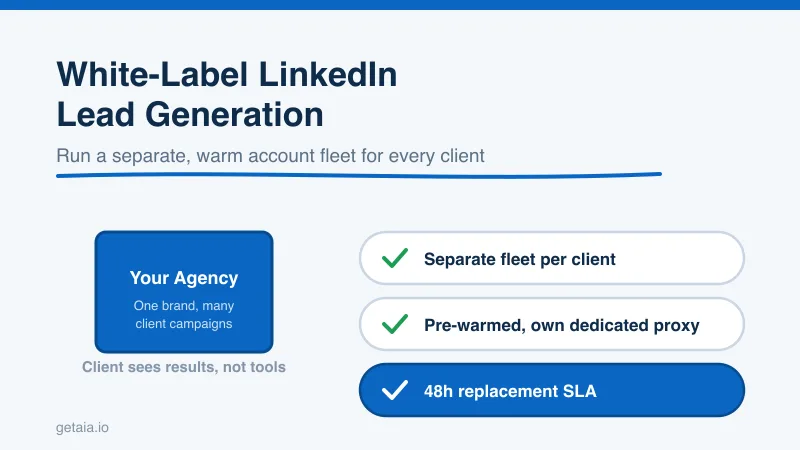
White-label means the client sees your brand, not the tools. They get a report that says meetings booked, and they never think about the machinery. For that illusion to hold, three things have to be true at once, and each one has an account-layer implication most new agencies miss.
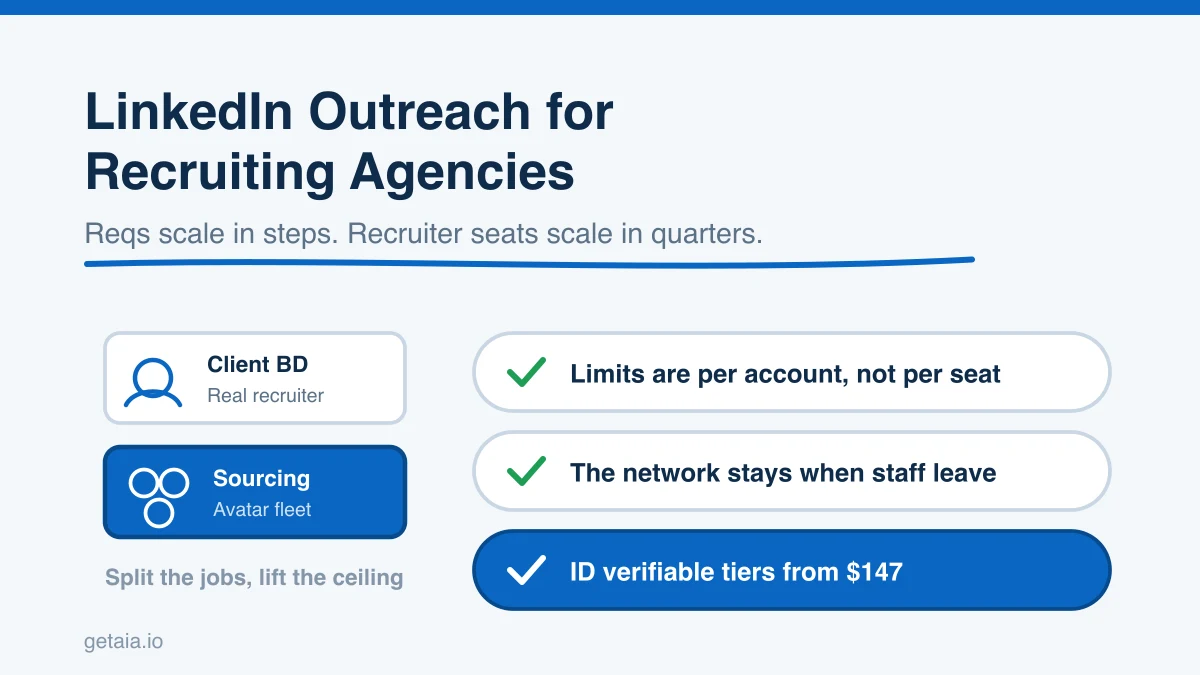
First, every client needs their own separate sending identities. You cannot run outreach for Client A and Client B from the same pool of LinkedIn accounts. The messaging is different, the target lists are different, and if one client’s campaign trips a restriction, it must never take down another client’s sending. Separation is not a nice-to-have, it is the difference between one bad week and a chain reaction across your whole book.
Second, those identities have to be healthy and warm before they send a single message. A brand-new LinkedIn account that starts firing connection requests on day one gets flagged fast. Warming a profile by hand takes weeks of slow, careful activity, and multiply that by every client and every seat and you are running a warming operation instead of an agency.
Third, when an account does get restricted, and across a large fleet some always will, you need a replacement fast. If a client’s campaign goes dark for two weeks while you scramble to warm a new profile, you have already lost the renewal. Speed of replacement is what keeps a white-label promise intact.
Put those three together and you get the real requirement: a supply of separate, pre-warmed, quickly replaceable LinkedIn accounts, each able to run on its own dedicated proxy, that you can spin up per client on demand. That supply is the product underneath your product.
Why Most Agencies Build This The Hard Way
The instinct is to source accounts cheaply and warm them yourself. Buy some aged profiles from a marketplace, spin up a few tools, and hope it holds. It rarely does, and the reasons are always the same.
Cheap resold credentials come with no proxy discipline and no warming, so they sign in from the wrong location and get flagged inside days. Warming profiles by hand does not scale past a handful, because the work grows linearly with every seat you add. And when a profile dies, you are back to square one with no fast replacement, so the client feels the outage directly.
There is also the tooling trap. Plenty of popular LinkedIn automation tools do not let you assign a dedicated custom proxy per account, which is the one thing a multi-client fleet cannot live without. If you want a fuller breakdown of which tools respect per-account proxies and which do not, our guide to LinkedIn automation tools that work with rented and avatar accounts covers exactly that test. The short version: your automation tool handles the campaigns, but it does not give you healthy accounts to run them on. That is a separate layer, and it is the one that decides whether your agency scales.
The Account Layer That Makes White-Label Work
Here is the cleaner way to build it. Instead of sourcing and warming accounts yourself, you rent a managed account layer and point your automation tool at it. That layer is what AIA avatars provide, and it maps onto the white-label requirements almost one to one.
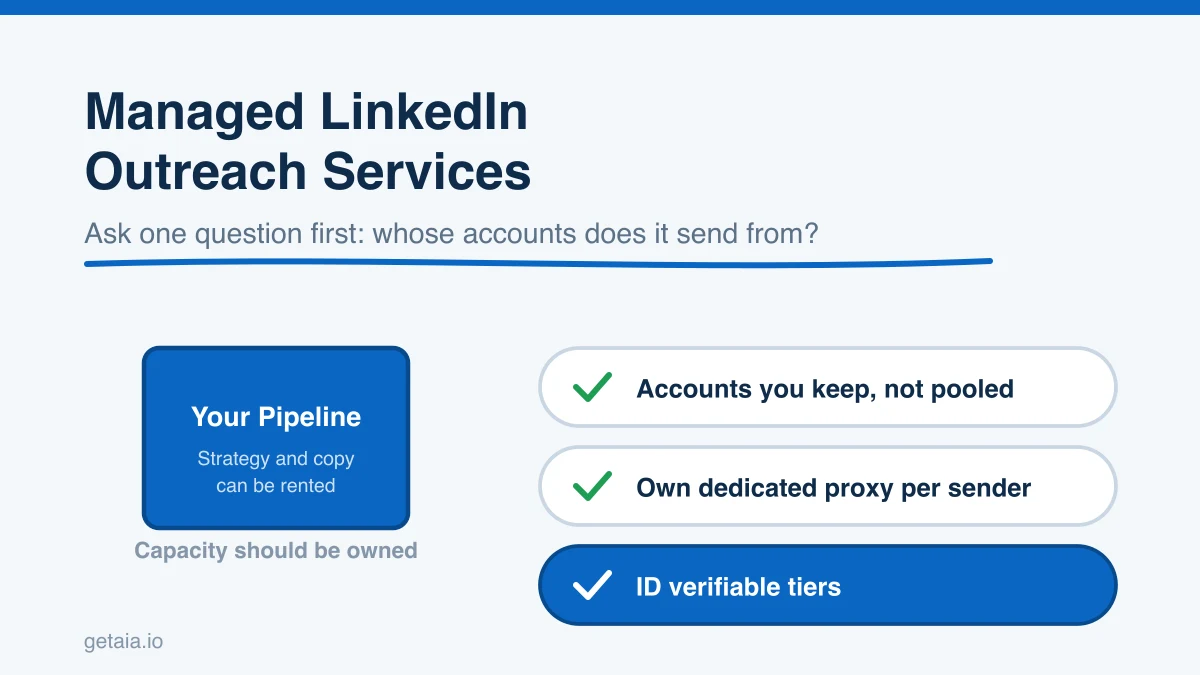
Each avatar arrives pre-warmed with 100 or more real connections, so it is ready to send inside safe limits from day one instead of after weeks of hand warming. Each one is a separate identity you attach to its own proxy, so every client’s accounts sign in from their own stable IP and stay separated from every other client. And when a profile does get restricted, the 48-hour replacement SLA swaps it out, so your client’s campaign barely notices instead of going dark for a fortnight. That is the whole shape of a white-label program: separate, warm, replaceable identities you can provision per client without running a warming factory yourself.
Because the accounts are managed rather than resold credentials, you are renting infrastructure, not gambling on a marketplace listing. You decide how many seats each client gets, you run your campaigns through whatever proxy-friendly tool you prefer, and the account supply underneath stays healthy.
Pricing It So The Margin Holds
The reason the account layer matters so much to an agency is that it is your cost of goods. If it is unpredictable, your margins are unpredictable. AIA prices it as a flat monthly figure per profile, which makes it easy to build into a client quote:
- Gold at $147 per profile per month, ID verified
- Titanium at $197 per profile per month, ID verified
- Silver at $97 per profile per month
- Platinum at $177 per profile per month
Volume discounts of 10, 20, and 30 percent kick in at 10, 50, and 100 or more avatars, which matters enormously for a white-label agency because your account count only goes up as you add clients. The layer gets cheaper per seat exactly as you scale, so your margin widens instead of thinning. There are also pre-warmed email avatars at $11 per domain if you want to run multi-channel sequences that pair LinkedIn with email. You can see the full breakdown on the AIA pricing page.
Run the simple math on a mid-size book. Say you serve ten clients at ten sending accounts each, so 100 avatars. On the Silver tier with the 30 percent volume discount, that is $97 times 0.70 times 100, which is $6,790 per month for your entire account layer, with dedicated proxies and replacements included. If each client pays you a few thousand a month for managed outreach, the account layer is a small, predictable slice of revenue rather than a source of surprise costs. That predictability is what lets you quote clients with confidence.
Why ID Verification Earns Its Place In A Client Program
When you are sending cold on a client’s behalf, trust signals move reply rates, and reply rates are the number your client actually judges you on. A profile carrying a genuine verification badge gets more requests accepted and more messages answered than an unverified one. The ID-verified tiers, Gold and Titanium, build that badge into the account layer itself, so your highest-value client campaigns lead with credibility. Because the accounts are managed, that verification is part of the infrastructure you rent, and any replacement comes verified too, so a restriction never costs a client their trust badge.
For a white-label agency, this is a lever you can sell. Offer your premium clients a fleet of ID-verified senders and you have a tangible upgrade tier that justifies a higher retainer.
What This Looks Like In Practice
The practical picture is straightforward. You keep your automation tool, your copywriting, your reporting, and your client relationships, all under your own brand. Underneath, you provision a block of avatars per client, each on its own proxy, warmed and ready. You run campaigns inside safe daily limits, you watch the replies, and when a profile gets restricted you file for a replacement and keep moving. The client sees meetings booked. They never see the machinery.
This is not theory. A top-100 US agency, running as an AIA client, ran 185 avatars and generated more than 500 SQLs and $2.3M in net-new revenue in under 90 days. That kind of output does not come from a handful of hand-warmed profiles. It comes from a large, healthy, replaceable fleet feeding proxy-friendly outreach tools, which is exactly the structure a serious white-label program needs.
The Honest Note On Platform Risk
No account model removes platform risk, and you should never sell one that claims to. LinkedIn actively works to detect automation and will restrict accounts that push too hard, no matter whose tool or accounts you use. Anyone promising unbannable profiles is not being straight with you or with your clients. What reduces the risk is careful daily limits, warm accounts, a dedicated proxy per profile, and ID verification on your top senders. What contains the risk when a restriction still happens is the 48-hour replacement SLA. A managed account layer gives you both the mitigation and the containment, which is what lets you make a white-label promise you can actually keep.
Getting Started
If you are building or scaling a white-label LinkedIn lead generation service, start by separating the two layers in your head: the tool that runs campaigns, and the account supply that keeps healthy senders underneath it. Pick a proxy-friendly automation tool, then give it an account layer built to scale per client. The AIA integrations page shows how avatar accounts connect to the major proxy-friendly tools, and the setup guide walks you from zero to a running fleet.
Want a fast recommendation on how many standard or ID-verified profiles fit your client book? Message us on WhatsApp at wa.me/37256084933 and we will size it with you. You can also start from the homepage at getaia.io to see how the whole account layer fits together.
Ready to build a white-label program on an account layer that actually holds up? Visit app.getaia.io to place your order, or start with the AIA pricing page to size your fleet and lock in volume discounts before you commit.