LinkedIn Outreach for Recruiting Agencies: Adding Sourcing Capacity Without More Recruiter Seats
Recruiting agencies hit the LinkedIn ceiling faster than anyone else, because every profile is doing two incompatible jobs at once and the volume cap is per account, not per seat. Here is how to separate business development from sourcing, scale senders horizontally, keep the candidate network when a recruiter leaves, and where the honesty line sits.
Your agency signs a client with fourteen open requisitions. The client wants a shortlist in three weeks. You have five recruiters, each already carrying a full desk, and the only lever you have is to push more outreach through the profiles you already have.
So you do, and within a fortnight two things happen. Your best recruiter’s LinkedIn starts throwing the “you have reached the weekly invitation limit” warning by Wednesday, and your business development messages to hiring managers stop landing because the same profile has spent the week pitching roles to candidates.
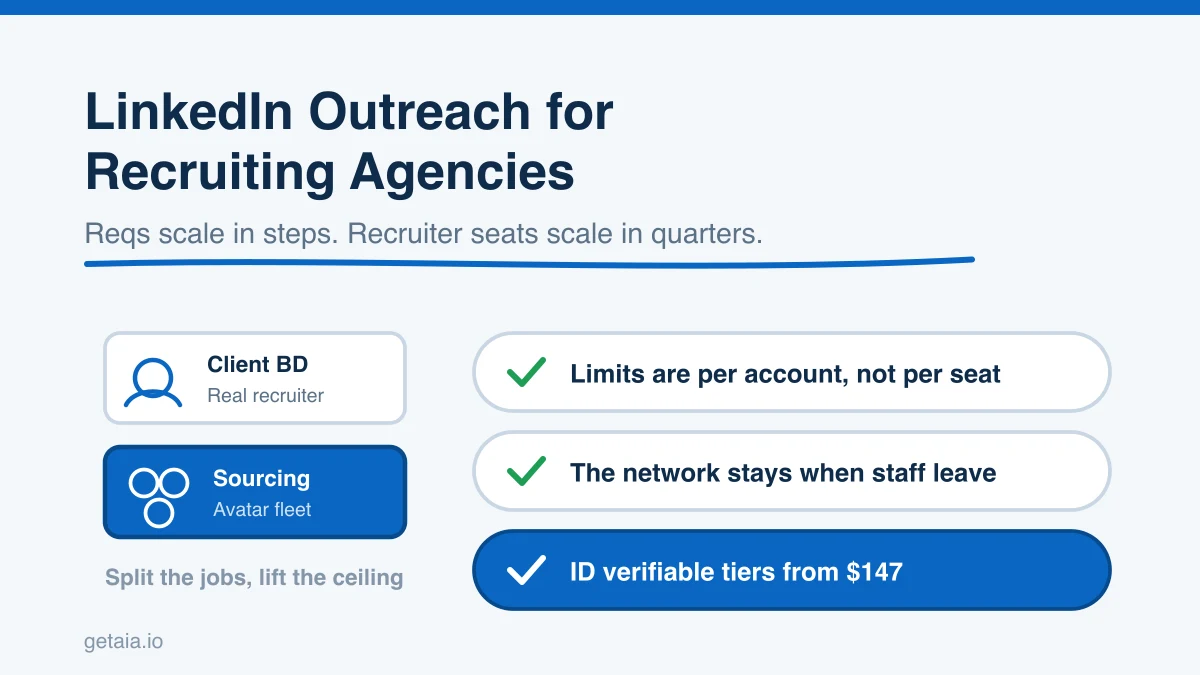
This is the structural problem in recruitment outreach and almost nobody names it. Requisitions scale in steps. Recruiter headcount scales in quarters. LinkedIn sending capacity does not scale at all unless you add accounts, because every meaningful limit on the platform is enforced per account, not per seat and not per license.
This guide covers why recruiting hits that ceiling harder than B2B sales does, why one profile doing both business development and sourcing is costing you both, what happens to your candidate network when a recruiter resigns, the arithmetic on adding sender capacity instead of headcount, and the honesty line you should not cross.
Why Recruiting Hits the LinkedIn Ceiling First
A B2B sales team sends to one audience. A recruiting agency sends to two, and the volume requirement on each side is independently brutal.
On the candidate side, the funnel is wide by nature. To place one engineer you may touch sixty profiles, because most of them are not looking, several are not qualified once you read past the headline, and the ones who are interested have four other recruiters in their inbox the same week. On the client side, business development is a straight outbound motion against hiring managers and talent leaders who are pitched constantly.
Now layer on the limits. LinkedIn caps connection invitations per account per week, caps the InMail allowance attached to a seat per month, and gets progressively less tolerant the harder a single profile pushes. Buying a more expensive license does not lift the invitation ceiling. It gives you better search and more InMail credits, which helps you find people and does nothing for how many of them you can actually approach from that one identity.
So the capacity equation for an agency is simple and uncomfortable: your monthly outreach ceiling equals your number of sending profiles multiplied by a safe per-profile volume. Only one of those two numbers is yours to change, and it is not the second one. Pushing the per-profile number is exactly how accounts get restricted, which we have written about in detail in what to do when LinkedIn restricts your account.
One Profile, Two Incompatible Jobs
Here is the specific damage most agencies are carrying without measuring it.
A recruiter’s personal LinkedIn profile is simultaneously a sourcing tool and a business development tool. As a sourcing tool it needs to look like a credible specialist recruiter in a niche, with content and a headline aimed at candidates. As a business development tool it needs to look like a commercial partner who solves hiring problems for a VP of Talent.
Those are different positioning statements, and a profile cannot hold both without diluting each. The headline that converts candidates (“I help platform engineers find roles at Series B companies”) reads as a vendor pitch to the hiring manager you are trying to win. The headline that converts clients reads as sales to the candidate.
It gets worse at the activity level. Candidate sourcing is high volume and low personalisation by necessity. Client business development is low volume and high personalisation. Running both from one account means the account’s behaviour profile looks like bulk outreach, and your careful fifteen-message week to target accounts inherits the restriction risk created by your four-hundred-message candidate push.
The fix is not better copy. It is separate identities for separate jobs: one set of sending profiles for candidate sourcing at volume, and your senior recruiters’ own real profiles reserved for client relationships, where the personal brand is genuinely the asset. That split is the single highest-leverage change available to most agencies, and it is only possible if you can provision sending profiles independently of hiring people. Our avatar accounts exist for exactly that layer: profiles that carry the sourcing volume so your recruiters’ own profiles stay clean for the commercial conversations that need a real name behind them.
The Question Nobody Asks Until a Recruiter Resigns
Recruitment has high staff turnover. Everyone in the industry knows it and most agencies still build their entire outreach operation on an asset that walks out of the door with the person.
When a recruiter leaves your agency, the LinkedIn profile goes with them. So does every candidate connection they made on your time, every hiring manager relationship they built on your client list, and every conversation thread in that inbox. If they join a competitor, which in staffing they often do, your agency funded the network they will use to compete with you.
Compare that to a sourcing fleet the agency owns. The profiles are provisioned to the business, the connections accumulate on the business’s balance sheet, and when a recruiter leaves you reassign the desk and the new person inherits a warm network instead of starting from a blank search. The departing recruiter still takes their own relationships, as they should, but they no longer take your sourcing infrastructure with them.
This is the same argument we made about managed outreach vendors and pooled accounts, and it applies with more force inside a staffing firm, because the churn rate is higher and the network is the product.
The Arithmetic Against Adding Headcount
The honest comparison is not avatar accounts versus nothing. It is sender capacity versus recruiter capacity, for the specific job of getting more first-touch volume into the market this month.
A recruiter is a salary, employer costs, a desk, a license, a ramp period before they are productive, and a hiring cycle before they even start. All of that is the right spend when you need judgement: qualifying candidates, running interviews, managing the client. None of it is the efficient way to buy raw first-touch volume, and raw first-touch volume is what a fourteen-requisition sprint actually needs.
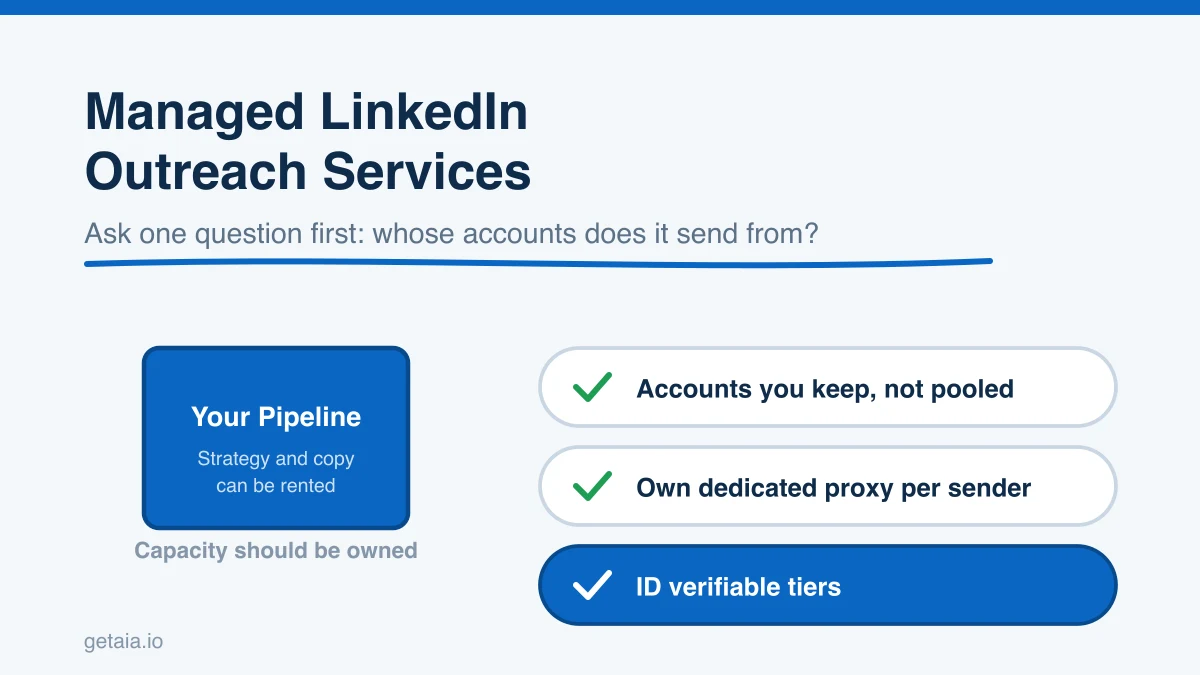
Sender capacity prices differently. Our accounts run at $147 per profile per month on the Gold tier, which is ID verifiable and arrives with 100 or more existing connections, $177 on Platinum and $197 on Titanium, both of which carry 500 or more connections, and $97 on Silver. Volume discounts are 10 percent off at 10 or more avatars, 20 percent at 50 or more, and 30 percent at 100 or more. Full numbers are on the AIA pricing page.
Ten Gold profiles with the volume discount is $147 times 0.9 times 10, or $1,323 per month, for ten independent ID verifiable sourcing identities that come pre-aged rather than needing a warm-up quarter. Put that against the fully loaded monthly cost of one additional recruiter in your market and then ask which one produces more first touches in the next thirty days. For most agencies the answer is not close, and the right answer is usually both: the senders for volume, the recruiter for the judgement the senders cannot provide.
Scale is also what moves the result more than messaging does. One AIA client, a top-100 US agency, ran 185 avatars to produce more than 500 sales-qualified leads and $2.3 million in net-new revenue in under 90 days. Per-account volume was deliberately conservative throughout. The account count was not.
The Tooling Trap
If you are running sourcing from accounts that are not your recruiters’ personal profiles, your choice of automation tool narrows sharply, and it narrows on architecture rather than features.
Several popular tools do not let you bring your own proxy per account, which means they cannot keep each profile on a stable, consistent IP. Dripify, Waalaxy, Zopto, Dux-Soup and Ulinc all fall into this group. Browser-extension tools are the worst fit of all for an agency, because a recruiter running three identities from one laptop puts three profiles behind one browser fingerprint and one residential IP, which is precisely the pattern LinkedIn looks for.
The tools that do accept a custom proxy per account are the ones that work here: LIA, Expandi, HeyReach, Skylead, We-Connect and Buzz. A LIA seat is $47 per month and pairs natively with our accounts. Our integrations page covers how each tool attaches and what the setup looks like per account.
Two practical notes for recruitment specifically. First, keep candidate sequences and client business development sequences in separate campaigns with separate daily limits, because the safe cadence for each is different. Second, route replies to a human fast. A candidate who answers at 9pm and hears nothing until Thursday is already in a process somewhere else.
Where the Honesty Line Sits
This part matters more in recruitment than in any other use case, so we are going to be direct about it.
Using additional sending identities to create outreach capacity is a volume decision. It is not a licence to misrepresent the job, the salary, the client, or whether a role exists. Candidates make career decisions based on what a recruiter tells them, and a sourcing message that oversells a requisition damages your agency’s reputation in a tight talent market far more than it damages anything else.
The arrangement that works, and the one we tell agencies to run, looks like this. The firm is real. The requisition is real. The description is accurate. The first touch opens a conversation at volume, and as soon as a candidate engages seriously they are handed to a named recruiter who owns the relationship through to placement. The sending layer buys you reach. It does not replace the person who has to be accountable to the candidate, and any agency treating it as a way to avoid that accountability will get found out by the market long before LinkedIn gets involved.
Our ID verified accounts matter here for the same reason. On the Gold and Titanium tiers the profiles are real people with an ID-backed or ID-verified badge, which is the standard a candidate being asked to consider a career move is entitled to expect.
The Honest Note on Platform Risk
No account layer, tool or sending strategy removes platform risk, and anyone telling you otherwise is selling you something.
LinkedIn actively detects and restricts accounts that behave like software, regardless of which tool is driving them or where the profile came from. Recruiting outreach carries slightly more exposure than average because candidate volume is high and recipients report messages that feel like spam, which is a signal the platform weights heavily.
What reduces the risk is unglamorous: conservative daily limits per profile, a slow ramp on anything new, profiles with real history rather than fresh signups, one stable IP per account through your own proxy setup, and ID verification on the identities doing the most sensitive work. What contains it when a restriction happens anyway is having a replacement path for the profile and a sequence that can hold a candidate’s interest while the sender is swapped. Spreading volume across more sourcing identities instead of pushing harder through fewer is the structural protection, and it is the same reason the fleet model beats the hero-recruiter model.
Getting Started
If you run a recruiting or staffing agency and your outreach ceiling is set by how many recruiters you employ, the fix is to decouple the two. Reserve your recruiters’ personal profiles for client relationships where the personal brand is the asset, move candidate sourcing volume onto profiles the agency owns, and pick a tool that can keep each one on its own IP.
The setup guide walks from zero to a running fleet, and getaia.io shows how the accounts and tool integrations fit together.
Not sure how many sourcing profiles fourteen open requisitions actually needs? Message us on WhatsApp at wa.me/37256084933 and we will size it against your placement targets, including whether standard or ID verified profiles are the right call for your candidate market.
Ready to stop capping your sourcing at your headcount? Visit app.getaia.io to place your order, or start with the AIA pricing page to size your fleet and lock in volume discounts before your next client sprint.