How to Run LIA With Rented and Avatar LinkedIn Accounts Without Burning Senders
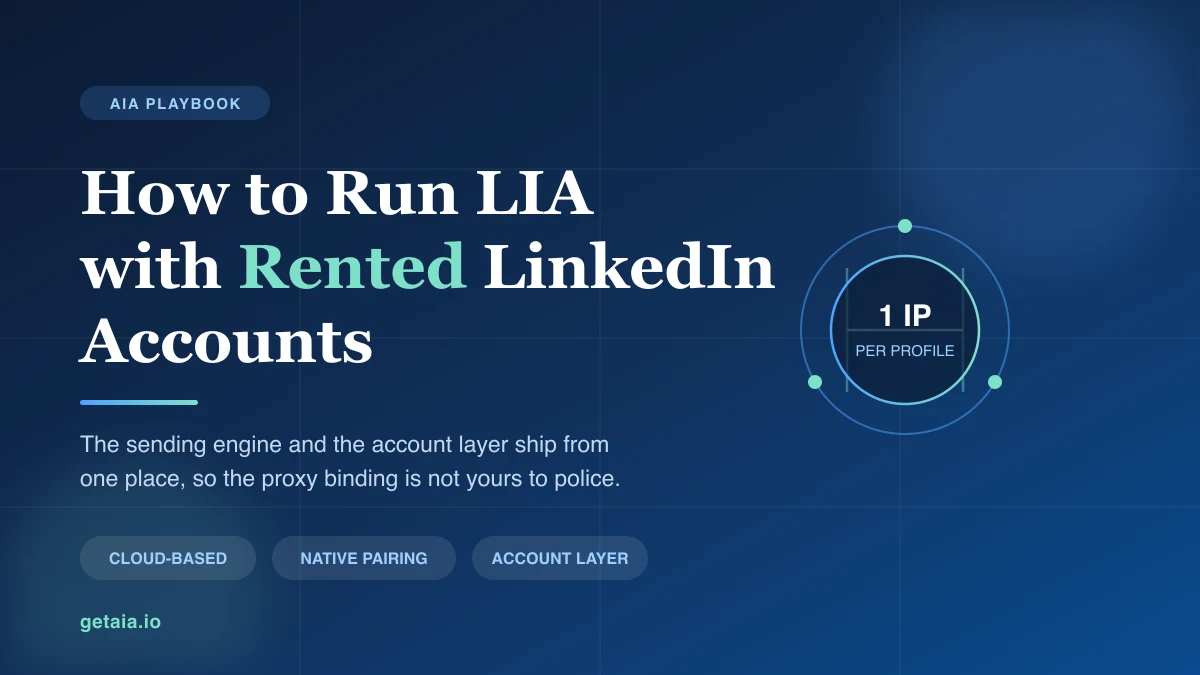
LIA is the one LinkedIn automation tool that ships from the same place as the accounts it sends from, which removes the proxy and fingerprint mismatch that breaks most fleets. Here is how to wire rented or avatar profiles into LIA, what the seat costs, and the setup order that catches problems before LinkedIn does.
Every guide in this series has the same shape. You pick a cloud-based LinkedIn automation tool, you confirm it accepts a custom proxy, you point it at rented or avatar profiles, and then you spend a week reconciling two systems that were never designed to know about each other.
LIA is the exception, for one structural reason: it is our own tool.
That is not a sales line, it is a description of where the seams are. When the sending engine and the account layer come from two vendors, you are the integration. You hold the proxy assignments, you notice when an IP rotates, you discover the fingerprint drifted only after a sender goes quiet. When they come from one place, those seams are not yours to manage.
This guide covers what LIA actually does, the specific class of failure that native pairing removes, what it costs, and the order to set things up in. It also covers what being the same vendor does not fix, because that part gets oversold.
What LIA Is
LIA, formerly and still known as LinkedAssist, is a cloud-based LinkedIn automation tool. On our LIA integration page we describe it plainly: it automates LinkedIn connection requests, follow-ups and messaging so your pipeline keeps moving without manual work.
Two properties matter more than the feature list.
It is cloud-based, with no Chrome extension. This is the first filter on any tool you plan to run on accounts that are not your own. A browser extension executes on your machine, from your IP, inside your browser profile. Run five rented accounts through one extension and you have handed LinkedIn five identities sharing one fingerprint and one residential IP. That is the single most common way a fleet gets flagged, and it is an architectural problem, not a settings problem. Tools like Dripify, Waalaxy, Zopto, Dux-Soup and Ulinc are out at this stage for the related reason that they do not let you bring your own proxy per account. LIA runs server-side, which is the precondition for everything below.
It is built to pair with the accounts. LIA and our avatar profiles are provisioned from the same side. You are not mapping a proxy list from one dashboard into another vendor’s sender settings and hoping the two stay in sync.
The Failure Native Pairing Actually Removes
Be precise about this, because it is narrower than it sounds and more important than it looks.
The usual multi-vendor setup has an account layer that assigns each profile a dedicated IP, and a sending tool that connects to LinkedIn on behalf of that profile. For the account to look consistent, the tool has to send through that exact IP, every time, and keep sending through it for the life of the account. Any drift and LinkedIn sees an established profile suddenly appear from somewhere new.
Drift happens in mundane ways. The tool updates its egress infrastructure. A proxy credential is rotated and only half the senders get the new one. Someone adds a sender in the tool and forgets to attach the proxy, so it quietly sends from the tool’s default IP. None of these throw an error. The campaign stays green. You find out when accept rates on one sender fall off a cliff and you spend three days blaming your copy.
When the account layer and the sending engine are the same system, the IP binding is not a thing you configure and then have to police. That removes a whole category of silent misconfiguration.
What it does not remove: volume mistakes, bad targeting, thin profiles, or LinkedIn deciding your sender is behaving like software. Native pairing fixes the plumbing. It does not fix judgment.
What It Costs
A LIA seat is $47 per month per seat as an exclusive AIA price, which is the number to use when you are sizing a fleet rather than pricing it standalone. One seat drives the automation; the profiles are priced separately, because the sender identity is the asset and the tool is the thing that operates it.
On the account side, our avatar profiles start at $97 per profile per month for Silver. The tier that matters for LIA campaigns at scale is Gold at $147, because it is the first ID-verified tier. Platinum is $177 and Titanium is $197, and Titanium is also ID-verified. Volume discounts run 10, 20 and 30 percent at 10, 50 and 100-plus avatars, so the per-sender cost of a real fleet is meaningfully below the sticker. The full grid is on the pricing page.
The reason to put ID verification on your primary senders rather than treating it as an upsell: verified profiles survive scrutiny that unverified ones do not. If a prospect checks, or LinkedIn asks, the verified identity has an answer. Competitors who sell real ID-verified accounts make this argument against avatars generally, and on the verification point specifically they are not wrong. That is exactly why our Gold and Titanium tiers exist. The choice is not avatars versus verified accounts; it is whether your avatar layer includes a verified tier, and ours does.
Proxies are the other half of multi-account safety, and you bring your own. If you want the detail on why the type of IP matters as much as its uniqueness, we covered it in residential versus datacenter proxies for LinkedIn.
Setup Order That Catches Problems Early
The order matters, because each step surfaces a different failure while it is still cheap.
First, provision the profiles and leave the automation off. Our avatars arrive pre-warmed and pre-aged with 100-plus connections, which is what makes it reasonable to start sending sooner than a cold profile would allow. It is not a reason to start sending on hour one. Log in, look at each profile, confirm it looks like a person you would accept a request from.
Second, connect the profiles to LIA and send nothing. Confirm every sender shows up, is attached to its own profile, and is live. A sender that silently failed to attach is the thing you are looking for here, and it is far easier to spot on an empty campaign than inside a running one.
Third, run one sequence on one profile. Not your whole fleet. One. Conservative daily limits, a short cadence, real targeting. You are establishing what normal looks like for a single healthy sender so that you have a baseline to compare the rest against. Teams skip this and then have no way to tell an account problem from a copy problem.
Fourth, roll out in small batches and watch per-sender numbers. Add a few senders at a time. The signal you care about is one sender diverging from the others on the same sequence and the same list. Same copy, same targets, one sender underperforming, means the problem is that account, not the campaign.
Fifth, scale by adding senders, not by raising limits. This is the discipline that separates fleets that last from fleets that get restricted in month two. When a campaign works, the instinct is to push more volume through the accounts you already have. Push horizontally instead. The arithmetic of that approach, and the point where it stops making sense, is in scaling LinkedIn outreach across 50 to 100 sender accounts.
One client ran this pattern hard: a top-100 US agency scaled to 185 avatars and produced 500-plus SQLs and $2.3M in net-new revenue in under 90 days. The volume per account was not remarkable. The number of accounts was.
The Honest Note on Platform Risk
Same vendor does not mean no risk, and anyone telling you otherwise is selling you something.
LinkedIn actively works to detect automation and restricts accounts that behave like software, whatever tool is driving them and whoever supplied the profile. Native pairing removes misconfiguration risk. It does not remove platform risk, because platform risk is not a bug in your setup, it is the counterparty having different interests than you.
What reduces it is unglamorous: conservative limits, a slow ramp, warm profiles with real history, one stable dedicated IP per account, ID verification on your primary senders. What contains it when a restriction lands anyway is a replacement path, which is what our 48-hour replacement commitment is for, and a sequence that can keep a prospect warm while the account is swapped. LIA gives you the cloud infrastructure and the native binding. A managed account layer gives you the mitigation and the containment.
Getting Started
If LIA is your sending engine, the remaining piece is an account layer built to scale with it. The setup guide takes you from zero to a running fleet, and the integrations page shows how the avatars connect into LIA and the rest of the cloud-based tools we support.
Want a quick read on how many standard or ID-verified profiles your target volume actually needs? Message us on WhatsApp at wa.me/37256084933 and we will size it with you. You can also start from getaia.io to see how the whole account layer fits together.
Ready to run LIA on a fleet that scales? Visit app.getaia.io to place your order, or start with the AIA pricing page to size your fleet and lock in volume discounts before you commit.