How to Run 50 to 100 LinkedIn Sender Accounts Without Getting Restricted
Running 50 to 100 LinkedIn sender accounts is how agencies and sales teams hit serious outbound volume. Here is the exact stack, safe daily limits, and account layer you need to make it work without triggering restrictions.
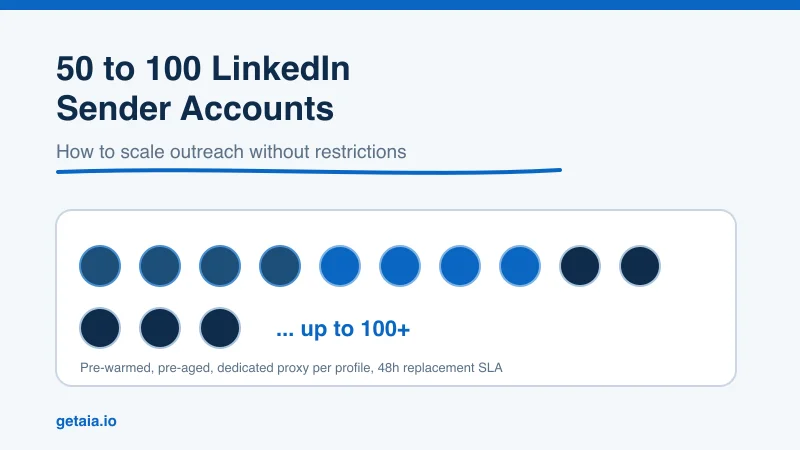
One LinkedIn account sending 20 to 30 connection requests per day gives you maybe 400 to 500 new contacts per month if every request lands. That is enough for a solo founder testing the waters. It is not enough for an agency managing 10 clients, a sales team with a real pipeline target, or anyone who wants to run outreach as an actual growth channel.
The teams hitting 5,000+ meaningful outreach touches per month are running 50 to 100 sender accounts. Here is exactly how that works, what breaks when you get it wrong, and the account layer that makes the whole stack hold together.
Why a Single Account Caps You
LinkedIn enforces daily and weekly limits at the account level, not the company level. A well-warmed account can safely send around 20 to 30 connection requests per day and 50 to 100 messages per day before the platform starts flagging unusual activity.
That ceiling is not going to move. LinkedIn has tightened it repeatedly over the past few years and the trend is not reversing. The only way to increase your total output is to increase the number of sender accounts running in parallel.
Fifty accounts at 20 requests per day is 1,000 requests per day. One hundred accounts is 2,000. That is the math agencies and serious sales teams are using.
The Three-Layer Stack
Scaling to 50 to 100 senders is not complicated, but it requires three things working together.
Layer 1: Automation tool with multi-account support
Not every LinkedIn automation tool can handle dozens of accounts. You need a platform built for volume. The tools that work at this scale are the ones that support custom proxies and true multi-account management:
- HeyReach is built specifically for agencies running outreach across many accounts. Its account rotation feature spreads a campaign across multiple senders automatically, so you hit volume without pushing any one account past safe limits. The unified inbox means every reply lands in one place.
- Expandi runs each account on its own dedicated IP. It is a stronger fit when you want highly personalized sequences per account and are managing a smaller fleet, but it scales to larger teams with the right account infrastructure.
- Skylead and We-Connect are also proxy-compatible tools that support multi-account setups with cloud-based operation, which keeps sessions stable across timezone shifts.
- Buzz and LIA round out the options for teams that want flexible outreach automation paired with their own account fleet.
Tools like Dripify, Waalaxy, Zopto, Dux-Soup, and Ulinc do not support custom proxies, which means they cannot safely run rented or avatar accounts. If you are building a fleet of 50 to 100 senders, those tools are off the table.
Layer 2: Dedicated proxies
Every sender account needs its own residential or mobile proxy with a stable IP tied to the account’s home country. Sharing an IP across multiple accounts is one of the fastest ways to trigger a mass restriction event.
The automation tools listed above either assign a dedicated IP per seat or let you bring your own proxy. Either way, each account should look like it lives on its own device in its own location.
Layer 3: The sender accounts themselves
This is where most scaling attempts fall apart. Teams try to scale by creating new LinkedIn accounts in-house, and LinkedIn flags them within days. New accounts with no history, no connections, and no engagement trail are transparent.
What you need is pre-warmed, pre-aged accounts that already look like real LinkedIn members. That means accounts with established connection counts, prior activity, a realistic profile, and ideally some form of identity verification.
Why Rented Avatar Accounts Are the Right Account Layer
When you are running 50 to 100 senders, you have two options for the account layer: create and warm accounts yourself, or rent them from a provider.
Creating accounts in-house at that scale is a full-time job. You need to manage the warmup phase for each one (typically 4 to 8 weeks of careful activity before running campaigns), handle replacements when accounts get restricted, and maintain the proxy-to-account assignments across your entire fleet.
Renting removes all of that. AIA avatar accounts come pre-warmed and pre-aged with 100+ connections already in place. You plug them into your automation tool, assign the proxy, and start sending. There is no warmup queue to manage.
When an account gets restricted, AIA replaces it within 48 hours. At 50 to 100 accounts, restrictions are not a question of if but when. A 48-hour SLA means your outreach operation keeps running instead of stalling while you rebuild an account from scratch.
What It Actually Costs at Scale
AIA pricing is per profile per month:
- Gold: $147 per profile (ID-verified)
- Titanium: $197 per profile (ID-verified, top tier)
- Silver: $97 per profile (standard)
- Platinum: $177 per profile
Volume discounts apply automatically: 10% at 10 or more profiles, 20% at 50 or more, 30% at 100 or more.
At 50 accounts on the Silver tier with the volume discount: $97 x 0.80 x 50 = $3,880 per month for the account layer.
At 100 accounts on the Silver tier with the 30% volume discount: $97 x 0.70 x 100 = $6,790 per month.
That is the cost for accounts that are ready to run on day one, with replacements covered. Compare that to the staff time and opportunity cost of building and managing the same fleet in-house.
The ID-verified tiers (Gold and Titanium) are worth considering for high-value outreach where account credibility matters. ID-verified accounts carry a verification badge that increases reply rates on cold outreach.
A Real Result at Scale
A top-100 US agency ran 185 AIA avatars and generated 500+ SQLs and $2.3M in net-new revenue in under 90 days. That result comes from combining the right automation tool with the right account infrastructure. The automation tool handles the sequencing. The account layer is what makes it sustainable.
Honest Note on Platform Risk
Running LinkedIn outreach at scale carries real platform risk. LinkedIn actively works to detect automation and restrict accounts that violate its terms. ID-verified accounts and careful daily limits reduce the risk, but they do not eliminate it.
That is why the 48-hour replacement SLA matters. You are not betting the whole operation on any single account staying alive. You are running a fleet where individual restrictions are a normal operating expense, not a crisis.
How to Get Started
If you are moving from a handful of accounts to 50 or more, the fastest path is:
- Pick your automation tool based on whether you need per-account personalization (Expandi) or volume rotation across many senders (HeyReach).
- Source your accounts from a provider that delivers pre-warmed profiles with a replacement SLA. You can see AIA’s full account options and integrations to understand how the account layer connects to your existing stack.
- Assign a dedicated proxy per account, tied to the profile’s home country.
- Start conservatively: 15 to 20 requests per day per account for the first two weeks, then ramp.
The AIA pricing page has the full tier breakdown and volume discount calculator. If you want to talk through the right setup for your team before committing, reach out on WhatsApp at wa.me/37256084933.
Ready to build your sender fleet? Visit app.getaia.io to get started or explore why AIA avatars are the account layer serious outreach teams rely on.