The Best Ulinc Alternatives for Running Rented and Avatar LinkedIn Accounts at Scale in 2026
Ulinc is a budget-friendly way to automate a couple of LinkedIn accounts, but its lack of custom proxy support gets in the way the moment you run rented or avatar accounts. Here are the LinkedIn automation tools that let you bring your own proxy, plus the account layer that makes scaling safe.
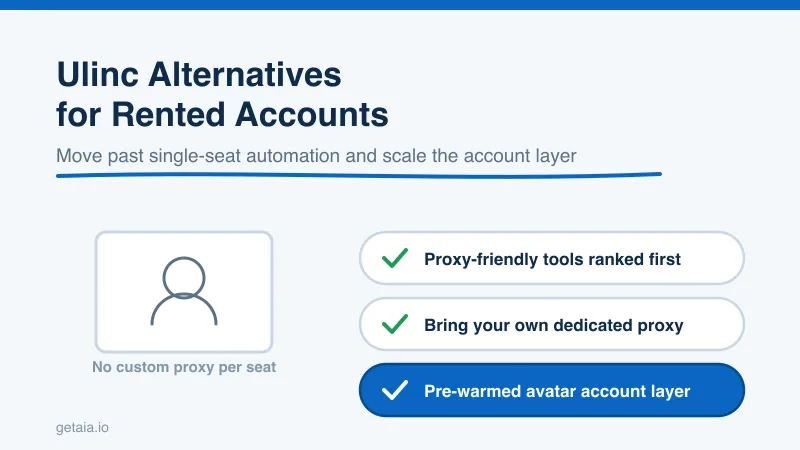
Ulinc earns its place on plenty of shortlists for one honest reason: it is cheap and it gets a single account sending without much fuss. If you run one or two profiles you own and you want simple LinkedIn automation without an enterprise price tag, it does the job. The problem shows up the moment your outreach needs to run across a fleet of rented, aged, or avatar accounts. That is where the thing that makes Ulinc attractive on a single seat, its simple all-in-one setup, quietly becomes the thing that gets accounts restricted.
This guide walks through why teams outgrow Ulinc, the checklist that actually matters when you replace it, and which tools hold up when your outreach lives across many sending identities instead of a couple. Every option here is judged on one question that beats any feature comparison: can it safely run the account layer you plan to scale on.
Why Teams Look For a Ulinc Alternative
Ulinc is built to be simple and affordable, which is exactly why it works on a small footprint and struggles once you grow. The limits tend to surface in two places.
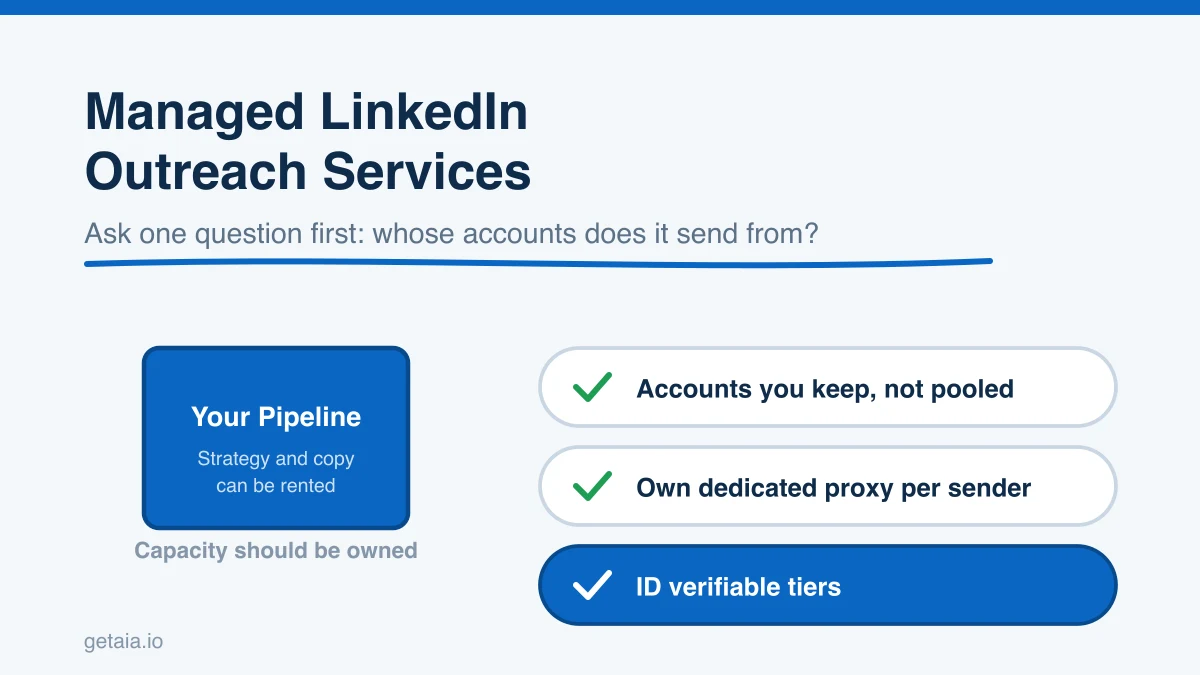
The first is the proxy problem, and this is the one that quietly gets accounts restricted. To run multiple LinkedIn accounts safely, each account needs to look like a separate real person in a consistent location. That means a dedicated proxy per account, so every profile keeps its own stable IP. Ulinc does not let you bring your own custom proxy for each account and assign it per profile the way a fleet needs. That is fine if you are automating a single profile you created and log into from your own connection. It becomes a real conflict the moment you want to run rented or avatar accounts, because those accounts need to sign in from one consistent IP every time. Force them through a tool that does not respect a per-account proxy and you get exactly the mismatched, shifting footprint LinkedIn is best at flagging.
The second is scale shape. Ulinc is priced and designed around a handful of accounts, not a coordinated fleet of fifty or a hundred senders under one roof. When your account count is the thing that drives revenue, a tool that treats every profile as a separate little island, with no shared inbox, no fleet-level safety controls, and no volume economics, quietly caps how far you can push.
So the real question is not just “what is a cheaper or simpler Ulinc.” It is “what tool lets me run many rented or avatar accounts, each on its own dedicated proxy, managed as one fleet instead of a pile of disconnected seats.”
What To Look For In A Replacement
Before the list, here is the checklist that separates a tool you can scale on from one you will outgrow again in a quarter:
- Custom proxy support per account. Non-negotiable for running rented or avatar accounts. Each profile needs to sign in from its own dedicated IP, the one it was warmed on.
- Pricing that rewards scale. Look for volume breaks and workspace pricing, not a flat per-seat fee that only grows with your account count.
- Multi-account management. A single dashboard built to run many senders, not one seat cloned many times.
- Safe, configurable limits. Per-account daily caps that mimic human behavior instead of blasting volume.
- Multi-channel reach. The strongest tools pair LinkedIn with email so one identity works more than one channel.
Judge every alternative below against that list, not against how cheap or simple it looks on a single seat.
The Best Ulinc Alternatives For Scaling Outreach
These are ranked by how well they run a fleet of separate accounts on their own proxies, which is the whole point of moving past a single-seat tool.
1. Expandi
Expandi is cloud based, lets each account run on its own dedicated proxy and country location, and was built from the start for agencies and teams running many profiles. Smart limits and warm-up sequences keep sending inside safe daily ranges. If your reason for leaving Ulinc is that you need many rented or avatar accounts each signing in from a clean, consistent IP, Expandi is the most direct upgrade.
2. HeyReach
HeyReach is purpose built for agencies and teams running LinkedIn outreach at volume. It handles many accounts under one roof, supports proxy assignment per account, and lets you pool inboxes so a whole team can work replies together. Its workspace pricing tends to scale far more kindly than paying for one disconnected seat at a time, so if your plan is dozens of senders, HeyReach is designed for exactly that shape of work.
3. Skylead
Skylead runs smart sequences that combine LinkedIn touches with email in a single flow, so one identity works more than one channel. It is cloud based and supports the per-account setup you need to run multiple profiles safely. For teams that want multi-channel from one seat without the enterprise price, Skylead earns its place.
4. We-Connect
We-Connect is a cloud platform with solid multi-account support and safety controls, aimed at teams that want reliable sending without babysitting a browser. It is a steady, sensible step up from Ulinc when your priority is dependable per-account sending across a growing fleet.
5. Buzz and LinkedIn Automation Assistants
Buzz and similar assistant style tools round out the proxy-friendly options. They support cloud sending and per-account configuration, and pair well with a managed account layer underneath them.
A quick honest note on the tools that fall short on custom proxy support. Alongside Ulinc, that group includes Dripify, Waalaxy, Zopto, and Dux-Soup. They can be fine on a single account you own, but they are not built to let you bring your own dedicated proxy for each rented or avatar profile. Force several rented accounts through a tool that does not respect a per-account proxy and you are inviting the exact restrictions you are trying to avoid. For a fuller breakdown of which tools pass and which fail on this test, see our guide to LinkedIn automation tools that work with rented and avatar accounts.
The Half Of The Stack Nobody Sells You: The Account Layer
Here is the piece switching tools alone will not solve. Moving from Ulinc to a proxy-friendly tool like Expandi or HeyReach is only half the stack. The other half is the accounts you run through it. A great cloud tool pointed at a couple of profiles still hits the same weekly ceiling as before. To actually scale, you need a supply of healthy, warmed, separate sending accounts, each with its own proxy, feeding your tool of choice.
That is the layer AIA avatars provide. Instead of buying disposable credentials or spending weeks warming new profiles by hand, you rent a managed account layer that plugs into the automation tool you already picked. Each avatar arrives pre-warmed with 100 or more connections and is ready to run inside safe limits from day one. When a profile does get restricted, and across a large fleet some always will, the 48-hour replacement SLA swaps it out so your campaigns keep moving.
On pricing, the tiers are transparent and monthly rather than a per-seat fee that only grows with every account:
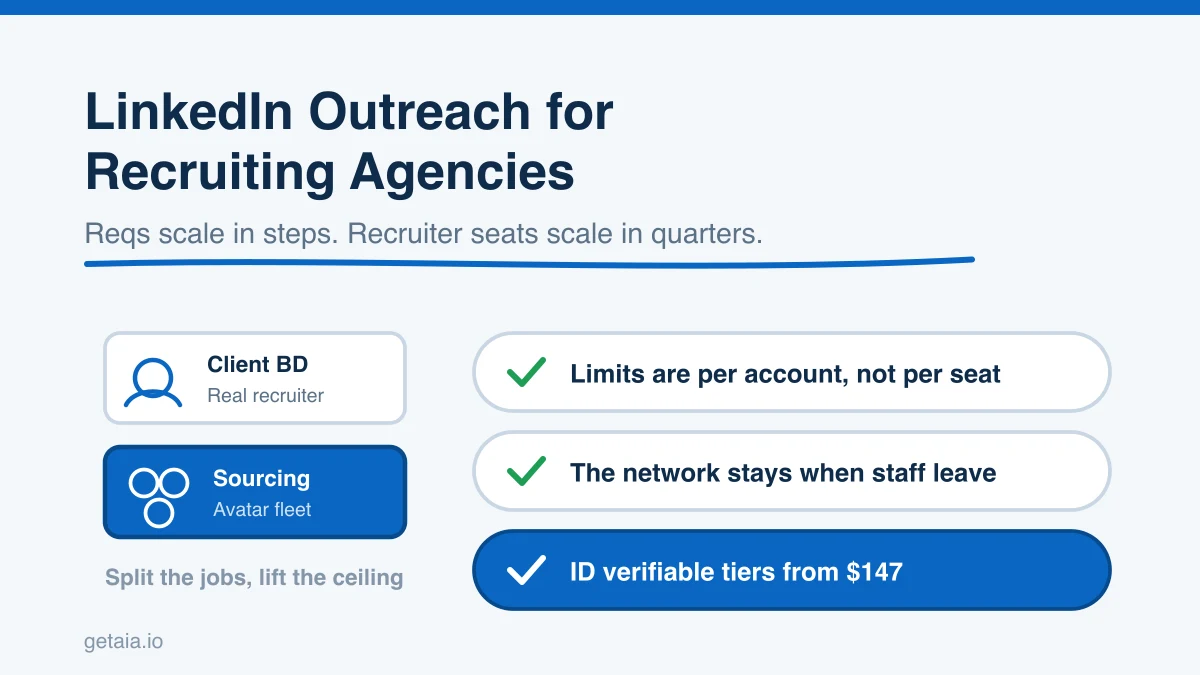
- Gold at $147 per profile per month, ID verified
- Titanium at $197 per profile per month, ID verified
- Silver at $97 per profile per month
- Platinum at $177 per profile per month
Volume discounts of 10, 20, and 30 percent kick in at 10, 50, and 100 or more avatars, so the account layer gets cheaper as you scale rather than more expensive. There are also pre-warmed email avatars at $11 per domain if you want to run the multi-channel sequences that tools like Skylead support. You can see the full breakdown on the AIA pricing page.
Why ID Verification Matters On Cold Outreach
When you are sending to people who have never heard of you, trust signals move reply rates. A profile carrying a genuine verification badge simply gets more requests accepted and more messages answered than an unverified one. The ID-verified tiers, Gold and Titanium, build that badge into the account layer itself, so your highest-value senders lead with credibility. Because the accounts are managed rather than resold credentials, that verification is part of the infrastructure you rent, and if a profile is ever replaced, the replacement comes verified too.
What Scaling This Way Actually Looks Like
Here is the practical picture. Say you switch from Ulinc to HeyReach and want to run 100 sending accounts through it.
Run 100 AIA avatars on the Silver tier with the 30 percent volume discount and it is $97 times 0.70 times 100, which is $6,790 per month, with dedicated proxies and replacements included. Compare that to trying to stitch together 100 disconnected single-account seats with no shared inbox, no fleet-level safety controls, and no scale break. The accounts arrive pre-warmed, so you also skip the weeks of manual warming a fresh profile still needs before it can safely send. Your tool handles the campaigns, and the account layer keeps a steady supply of healthy senders underneath it.
This is not theory. A top-100 US agency, running as an AIA client, ran 185 avatars and generated more than 500 SQLs and $2.3M in net-new revenue in under 90 days. That output does not come from a couple of budget seats. It comes from a large, healthy, replaceable fleet feeding a proxy-friendly outreach tool.
The Honest Note On Platform Risk
No tool and no account model removes platform risk. LinkedIn actively works to detect automation and will restrict accounts that push too hard, whether you run Ulinc, Expandi, or anything else. Anyone promising unbannable accounts is not being straight with you. What reduces the risk is careful daily limits, warm accounts, a dedicated proxy per profile, and ID verification on your top senders. What contains the risk when a restriction still happens is the 48-hour replacement SLA. Switching tools helps with proxy control and fleet management, but only a managed account layer gives you both the mitigation and the containment.
Getting Started
If you are shopping for a Ulinc alternative, start by picking a tool that supports custom proxies and manages many accounts as one fleet, then give it an account layer built to scale. The AIA integrations page shows how avatar accounts connect to Expandi, HeyReach, and the other proxy-friendly tools above, and the setup guide walks you from zero to a running fleet.
Want a fast recommendation on which tool and how many standard or ID-verified profiles fit your team? Message us on WhatsApp at wa.me/37256084933 and we will size it with you. You can also start from the homepage at getaia.io to see how the whole account layer fits together.
Ready to move past single-seat automation and actually scale? Visit app.getaia.io to place your order, or start with the AIA pricing page to size your fleet and lock in volume discounts before you commit.