LinkedIn Outreach for IT Services and MSPs: Winning Trust Before the Contract Renews
MSP buyers rarely switch providers on impulse. They switch when the current one lets them down, and they pick someone they already recognise. Here is how to build LinkedIn outreach around that: territory lanes, persona-matched senders, a slow cadence, and the honesty line for a trust-based sale.
Most outbound advice assumes the buyer can say yes this quarter. Managed IT does not work like that.
A business that already has an IT provider is usually locked into a contract, has its passwords, its firewall and its backups sitting with someone else, and has no appetite for a migration project. It does not switch because your message was clever. It switches when something goes wrong with the current provider: a slow response during an outage, a security scare, a surprise invoice, a key engineer who left. When that moment arrives, the decision maker calls the name they already recognise.
So LinkedIn outreach for an MSP is not really a meeting machine. It is a recognition machine that occasionally books a meeting. The job is to be the familiar, credible name in a defined territory at the moment the incumbent slips. That changes almost every decision about how you run it.
This guide covers how to define the market you are covering, why one founder profile is not enough, how to match senders to the people who actually sign, the cadence that fits a long switching cycle, and the honesty line for a sale built on trust.
Your Market Is a Map, Not a List
Most MSPs sell inside a geography, or inside a vertical where they already have references: dental practices, law firms, accountancies, manufacturers, schools. That makes the addressable market small and specific. You can usually count it.
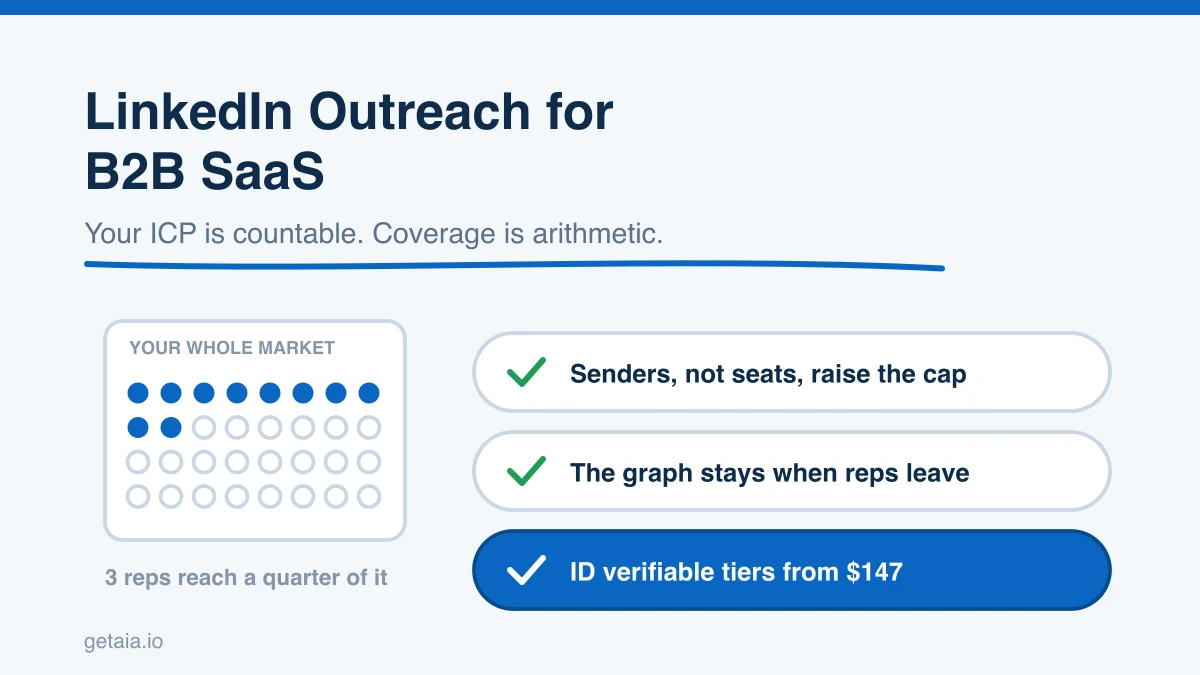
Start there. Write down the companies in your territory and vertical that fit your service model, then the two or three people at each who influence the decision. That number is your entire LinkedIn universe. It does not refresh itself next quarter.
Two things follow from a small, countable market.
You cannot afford to burn it. If the same profile messages the same office manager four times in six months, you have not built recognition. You have built an unsubscribe reflex. On a large market you would move on to fresh names. In a territory there are no fresh names.
Coverage beats intensity. The goal is to have a light, credible presence across the whole map, not a heavy presence on a slice of it. You want every decision maker in your territory to have seen your name, accepted a connection, and perhaps read a useful post, before anything goes wrong with their current provider.
Why the Founder’s Profile Hits a Ceiling
In most MSPs, outbound runs from the founder’s LinkedIn, sometimes with one salesperson helping. That works at the start, because the founder is credible and local. It stops working for three reasons.
The first is volume. LinkedIn enforces its activity limits per account. We recommend staying at or under 20 connection requests a day per profile, which is roughly what keeps an account looking like a person rather than software. Spread across a whole territory and several personas, one profile covers a small part of the map each year.
The second is the founder’s time. The founder is also the escalation point, the account manager for the biggest clients, and often the senior engineer. Outreach is the first thing that stops when a client has a bad week.
The third is risk concentration. If the only profile doing outbound is also the one your clients message when their server is down, a restriction on it is not a marketing problem. It is a client service problem.
Adding sending identities that the company controls solves all three. Coverage scales with the number of profiles, not the founder’s calendar, and the founder’s own profile stays reserved for the relationships where their personal reputation is the point.
Match the Sender to the Person Who Signs
IT services are bought by a small committee, and its members do not respond to the same voice.
- The owner or managing partner of a smaller firm cares about risk, cost predictability and not having to think about IT. They respond to a peer who talks about business outcomes.
- The operations or office manager lives with the day-to-day pain: slow tickets, onboarding new staff, the printer that never works. They respond to someone who clearly understands that pain.
- The in-house IT lead, where one exists, is evaluating whether you will make their life easier or replace them. They respond to technical credibility, and they are quick to spot a salesperson pretending to be an engineer.
One profile headlined “Business Development at YourMSP” is credible to maybe one of these. So build lanes. On AIA profiles you can specify the prior and present job and edit the headline and about section, which lets each sender read as a natural peer to the persona it messages: a service delivery background for the operations lane, a commercial background for the owner lane. Keep the company, the services and the claims identical across every lane. Only the voice changes.
Territory lanes work the same way. If you cover two cities or two verticals, give each its own sender so the local or vertical context in the profile is consistent with the message.
A Cadence That Fits a Long Switching Cycle
Because most prospects cannot switch this month, the cadence should be built for recognition over time rather than a fast close.
A pattern that fits:
- Connect with a short, specific note or none at all. Reference the territory or vertical, not your services. “We look after a number of practices around the city and I like to be connected with the people running them” is enough.
- Do not pitch on acceptance. A thank-you and nothing else. The connection is the asset.
- Be visible in the feed. Posts from your senders about local incidents, common security mistakes in their vertical, or what to check in an IT contract before it renews give connections a reason to remember the name.
- Ask one low-pressure question a few weeks later, usually about timing: “When does your current IT agreement come up for renewal?” The answer tells you when to come back, which is more useful than a meeting they do not need.
- Return when it matters. A note shortly before the renewal date, or after a widely reported outage or security incident in your area, lands when the decision is actually open.
Hold a single suppression list across every sender. Two of your own profiles messaging the same office manager in the same week is the fastest way to waste a finite territory.
For the automation layer, pick a tool that accepts a custom proxy per account, so each profile keeps its own stable IP. Our integrations page lists which tools work this way and how each one attaches.
What It Costs to Cover a Territory
Sending capacity is a monthly operating cost rather than a hire. From our pricing page: Silver is $97 per profile per month, Gold is $147 with an ID-backed or ID-verified badge and 100+ connections, Platinum is $177 with 500+ connections, and Titanium is $197 for a real-person ID-verified profile with 500+ connections. Volume discounts are 10% at ten profiles, 20% at fifty and 30% at a hundred, with no contracts. Every LinkedIn plan includes free setup with your automation tool, and the accounts come pre-aged and warmed up.
For most MSPs the useful comparison is not against another tool. It is against the founder’s hours. If a handful of profiles keeps your name in front of every decision maker in the territory while the founder gets back to clients, the arithmetic is usually straightforward.
Where the Honesty Line Sits
IT services are a trust sale, and buyers check. They will ask for references, read your reviews, and ask their peers. Anything a sender says has to survive that.
The arrangement that works is simple. The company is real. The services, certifications, response times and client references mentioned in any message are ones you actually have and can back up. Nobody claims a partnership, accreditation or local office that does not exist. And the moment a prospect engages seriously, they are introduced to a named person at the MSP who will own the relationship, usually the founder or the account manager.
Sending identities buy you coverage across a territory you could not otherwise reach. They do not buy you permission to overstate what you do. For identities doing the most trust-sensitive work, ID verified accounts on the Gold and Titanium tiers are the standard to use.
The Honest Note on Platform Risk
No account, tool or cadence removes platform risk. LinkedIn restricts accounts that behave like software, whatever their origin.
What reduces the exposure is unglamorous: conservative daily limits, a slow ramp on anything new, pre-aged profiles rather than fresh signups, one stable IP per account through your own proxy setup, and connection notes that read like a person wrote them. What contains it when a restriction happens anyway is having enough senders that losing one does not stall a territory, and a replacement path for the profile. Spreading the work across several identities at a gentle pace is both the safest way to run LinkedIn and the right way to cover a finite market.
Getting Started
Count your territory. List the companies that fit, the two or three people at each who influence the decision, and the lanes you need by persona and geography. Divide by what one profile can comfortably send in a year at a conservative pace, and you will know how many senders full coverage takes.
Then keep the founder’s profile for existing relationships, move coverage onto profiles the company controls, and choose a tool that keeps each profile on its own IP. The setup guide walks through it from zero.
Want help sizing it? Message us on WhatsApp at wa.me/37256084933 with your territory, your verticals and the personas you sell to, and we will suggest how many profiles and which tiers fit.
Ready to be the name they already know when the current provider slips? Visit app.getaia.io to place your order, or start with the AIA pricing page to plan your profiles.