LinkedIn Outreach for B2B SaaS: Covering a Finite ICP Without Burning Your List
B2B SaaS has a narrow, countable ICP, which makes the scarce resource credible distinct first touches rather than raw message volume. Here is the coverage arithmetic, why multi-persona selling needs more than one sender identity, what happens to your connection graph when an SDR churns at month fourteen, and where the honesty line sits.
Your board asks for 3x pipeline coverage next quarter. Your ICP is 6,000 companies. Your outbound team is three SDRs, and headcount is frozen until the next raise closes.
So you do the only thing available and push harder through the profiles you have. Six weeks later your best SDR’s LinkedIn is throwing weekly invitation warnings by Wednesday, your reply rate has halved, and when you look at why, it is not the copy. It is that the same 6,000 companies have now heard from the same three people four times this year.
This is the shape of the problem in SaaS outbound, and it is genuinely different from the problem a recruiting agency or an agency reseller has. Their prospect pool is effectively unbounded. Yours is not. You can count it. That single fact changes what you should optimise for, and most SaaS outbound teams are optimising for the wrong thing.
This guide covers the coverage arithmetic on a finite ICP, why selling to three personas needs more than one credible sender, what your connection graph is worth and who currently owns it, how sending capacity escapes the headcount approval cycle, and the honesty line you should not cross.
Your Constraint Is Coverage, Not Volume
Start with the number almost nobody on a SaaS outbound team has written down: how many distinct humans are actually worth reaching.
Take a realistic mid-market ICP. Companies between 200 and 2,000 employees, in three or four verticals, in North America and the UK. That is often somewhere near 6,000 accounts. Your buying committee is typically three people per account (the operational champion, the economic buyer, and a technical or security evaluator), so call it 18,000 reachable contacts. That is your entire addressable surface on LinkedIn. There is no fifth vertical waiting to be discovered next quarter.
Now the supply side. A single LinkedIn account running a conservative, sustainable cadence handles roughly 20 connection requests a day, which is about 400 first touches a month and somewhere near 4,800 a year. Those are deliberately unexciting numbers. You can push a profile harder for a few weeks, and plenty of teams do, right up until the restriction.
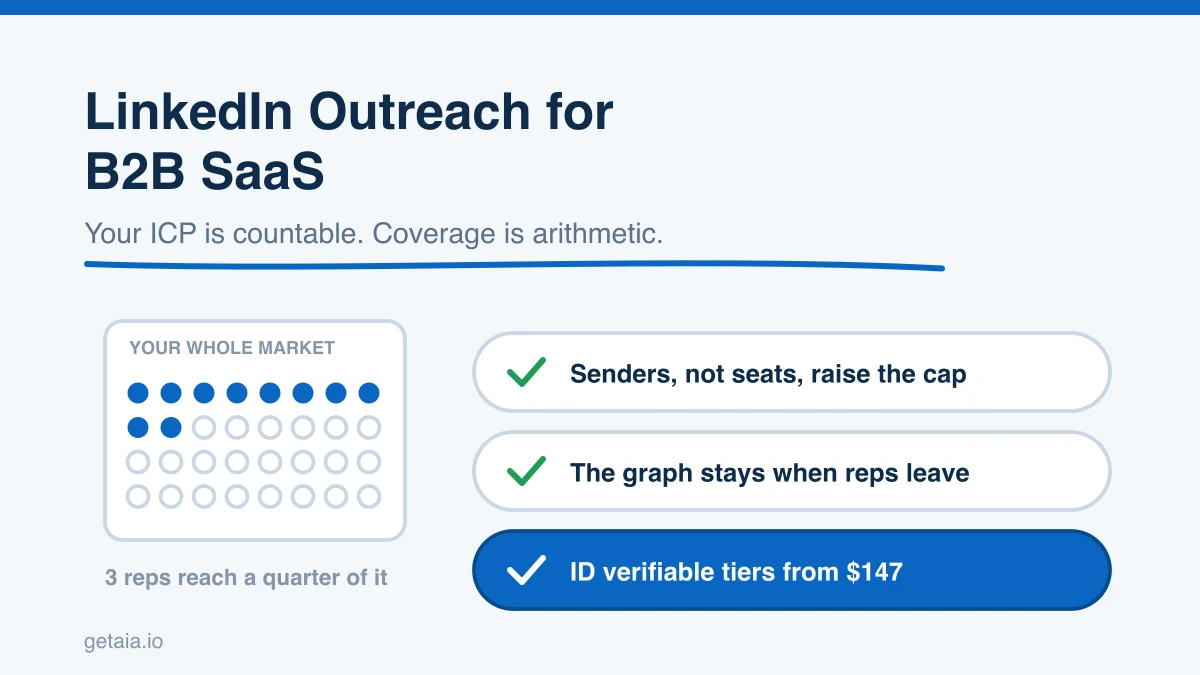
Put the two together and the arithmetic is unforgiving. Covering 18,000 contacts once a year takes about four accounts running continuously. Covering them with a realistic three-touches-a-year cadence, spread so that no individual sees the same sender twice, takes eleven or twelve. Your three SDR profiles can cover roughly a quarter of your market, once, per year.
That is the ceiling, and notice what it is not. It is not your messaging. It is not your tooling. It is not your SDRs’ work rate. It is a per-account limit multiplied by the number of accounts you have, and LinkedIn enforces every meaningful limit per account, not per seat and not per licence. Upgrading everyone to a more expensive licence does not raise the invitation cap. Only adding accounts does.
The second-order effect is the one that actually costs you money. When coverage is short, teams compensate by re-touching the same slice more often. On a finite list that is how you burn it. A prospect who has heard from your company five times in eighteen months from the same two profiles has learned to ignore the logo, and no rewrite fixes an audience that has already filed you as noise.
One Profile Cannot Be Three Credible Voices
SaaS does not sell to a person. It sells to a committee, and the committee members do not respond to the same sender.
A VP of RevOps evaluating your product wants to hear from someone who clearly does their job. A security reviewer wants a peer who can talk about SOC 2 and data residency without flinching. A CFO signing the contract wants seniority and a business case. Those are three different senders, and one SDR profile headlined “Account Executive at YourCo” is credible to at most one of them.
So most teams compromise. They send everything from the SDR profile, write the technical message in a voice the profile does not support, and watch the evaluator persona underperform by a wide margin without diagnosing why. The copy is not the problem. The sender is.
The fix is to match sender identity to recipient persona, which means you need more identities than you have people. On AIA profiles you specify the prior and present job and edit the headline and about section, so a sender can be built to read as a peer to the persona it is messaging rather than as a generic quota-carrier messaging everyone. Segment the same way you would segment a paid campaign: persona, vertical, and territory, with one sender owning each lane and a cadence slow enough to stay boring.
There is a routing benefit too. When each lane has its own sender, a reply arrives already classified. You know from which inbox it came whether you are talking to a champion or an evaluator, before anyone reads the message.
Who Owns Your Connection Graph
Median SDR tenure in SaaS is somewhere around fourteen to eighteen months. You already know this and you have probably budgeted for the backfill. What is rarely budgeted for is the asset that leaves with them.
When outbound runs from an SDR’s personal LinkedIn, the accepted connections into your finite ICP accumulate on their profile, not your company’s. So does the message history, the in-flight conversation with the prospect who said “not now, ask me in Q3”, and the warm second-degree path into accounts you have not touched yet. At month fourteen that entire graph walks out, and in many cases it walks to a competitor selling into the same 6,000 accounts. Your replacement starts from zero against a list that has already been worked.
On an unbounded prospect pool that is an annoyance. On a countable ICP it is a structural loss, because the connection graph into a finite market is the compounding asset of a SaaS outbound motion. It is the thing that makes year three cheaper than year one. Rebuilding it every fourteen months means it never compounds at all.
Company-owned sending identities invert this. The profile, the connections, the conversation history and the warm paths stay with the business. People rotate through the seat; the graph does not reset. This is the same argument we make to agencies about pooled vendor accounts, and it lands harder in SaaS precisely because your market does not refresh itself.
Sending Capacity Is Opex, Headcount Is Not
There is a procurement mismatch in SaaS that nobody names, and it is worth naming because it decides what you can actually do this quarter.
Pipeline requirements move quarterly, set by a board deck. Headcount moves on a hiring plan approved at the raise, and unfreezing it mid-quarter is a conversation with your CEO and sometimes your investors. A new SDR then takes a month to hire, a month to ramp, and a quarter before their LinkedIn is warm enough to carry real volume. The capacity you approve in January arrives in May.
Sending capacity does not work like that. It is a monthly operating cost on a line item you probably already control, it needs no req, and the accounts come pre-aged with existing connections rather than needing a warm-up quarter of their own.
The numbers, from our pricing page: Gold is $147 per profile per month and comes with an ID-backed or ID-verified badge and 100+ connections, Platinum is $177 with 500+ connections on proprietary profile technology, Titanium is $197 for a real-person ID-verified profile with 500+ connections, and Silver is $97. Volume discounts are 10% at ten profiles, 20% at fifty and 30% at a hundred. There are no contracts.
Run the earlier arithmetic against that. The twelve profiles it takes to cover an 18,000-contact ICP at three touches a year, on Gold with the volume discount, is $147 times 0.9 times 12, or $1,587 a month. Compare that to the fully loaded cost of one additional SDR in your market, then ask which one produces more qualified first touches into your actual ICP in the next ninety days. For most teams it is not close, and the right answer is usually both: the senders for coverage, the humans for the conversations coverage creates.
Scale is also what moves the outcome more than messaging does. One AIA client, a top-100 US agency, ran 185 avatars to produce more than 500 sales-qualified leads and $2.3 million in net-new revenue in under 90 days. Per-account volume stayed deliberately conservative throughout. The account count did not.
The Tooling Constraint Nobody Checks First
If your outbound runs from accounts that are not your reps’ personal profiles, your choice of automation tool narrows, and it narrows on architecture rather than on features.
Several popular tools will not let you bring your own proxy per account, which means they cannot keep each profile on a stable, consistent IP. Dripify, Waalaxy, Zopto, Dux-Soup and Ulinc all sit in that group. Browser-extension tools are the worst fit of all once you are past one or two identities, because running several profiles from one laptop puts them behind a single browser fingerprint and a single residential IP, which is exactly the pattern LinkedIn looks for.
The tools that do accept a custom proxy per account are the ones that work here: LIA, Expandi, HeyReach, Skylead, We-Connect and Buzz. A LIA seat is $47 per month and pairs natively with our accounts. Our integrations page covers how each tool attaches and what the per-account setup looks like.
Two SaaS-specific notes. Keep each persona lane in its own campaign with its own daily limits, because the safe cadence for a cold security reviewer is not the safe cadence for an operational champion who already follows your company page. And hold a central suppression list across every sender, or two of your own profiles will hit the same prospect in the same week, which on a finite ICP is the single fastest way to burn it.
Where the Honesty Line Sits
Using additional sending identities to create coverage is a volume decision. It is not a licence to misrepresent your product, your customers, your security posture or your pricing.
SaaS buyers do diligence. They will check your claims against your docs, your status page and their peer network, and a first touch that oversells capability costs you the account permanently rather than just costing you a reply. The arrangement that works is simple: the company is real, the product claims are accurate and match your own documentation, the case studies are ones you can actually name, and the moment a prospect engages seriously they are handed to a named human who owns the relationship through to close. The sending layer buys you reach into a market you could not otherwise cover. It does not buy you permission to say things that are not true.
ID verified accounts matter for the same reason. On the Gold and Titanium tiers the profiles are real people with an ID-backed or ID-verified badge, which is the standard a buyer being asked to put your software near their customer data is entitled to expect.
The Honest Note on Platform Risk
No account layer, tool or sending strategy removes platform risk, and anyone telling you otherwise is selling you something.
LinkedIn actively detects and restricts accounts that behave like software, regardless of which tool is driving them or where the profile came from. What reduces the exposure is unglamorous: conservative daily limits per profile, a slow ramp on anything new, profiles with real history rather than fresh signups, one stable IP per account through your own proxy setup, and ID verification on the identities doing the most sensitive work. What contains it when a restriction happens anyway is having a replacement path for the profile and enough senders that losing one does not stall a persona lane.
Spreading coverage across more identities instead of pushing harder through fewer is the structural protection, and it is the same decision that stops you burning your ICP. The two problems have one answer.
Getting Started
If your outbound ceiling is set by how many SDRs you employ, you are not capacity constrained so much as arithmetic constrained. Count your ICP, count your personas, divide by what one account safely sends in a year, and you will know how many senders the coverage you promised the board actually requires.
Then keep your reps’ personal profiles for the relationships where their personal brand is the asset, move coverage volume onto profiles the company owns, and pick a tool that can keep each one on its own IP. The setup guide walks from zero to a running fleet, and getaia.io shows how the accounts and tool integrations fit together.
Not sure how many senders your ICP actually needs? Message us on WhatsApp at wa.me/37256084933 with your account count and persona mix and we will size it against your coverage target, including whether standard or ID verified profiles are the right call for your buyers.
Ready to stop covering a quarter of your market once a year? Visit app.getaia.io to place your order, or start with the AIA pricing page to size your fleet and lock in volume discounts before the quarter starts.