LinkedSDR vs AIA: Rented Real Profiles or Prospecting Avatars for LinkedIn Outreach at Scale?
LinkedSDR rents real aged profiles run by real people. AIA gives you dedicated prospecting avatars across LinkedIn, email, and X. Here is an honest comparison of pricing, control, ID verification, and which one actually scales your outbound.
If you are comparing LinkedSDR and AIA, you are weighing two answers to the same question: how do you run LinkedIn outreach at real volume without burning your team’s personal profiles? Both give you an account layer. They get there in fundamentally different ways, and the difference matters more than the price on the pricing page.
LinkedSDR rents you profiles operated by real individuals. AIA gives you dedicated prospecting avatars you control. LinkedSDR sells the “real people, real IDs” story hard, and it is worth taking that claim seriously and then testing whether it actually buys you what you need. This is a fair breakdown of what each one gives you, where each one wins, and how to decide.
What LinkedSDR Actually Sells
LinkedSDR positions itself as a premium, US-focused marketplace for renting aged LinkedIn profiles that are run by real professionals. According to their own site, each rented profile comes with a real, ID-backed representative, a one year or older account history, 500 or more real connections, a dedicated US proxy inside a managed GoLogin workspace, 2FA support, a dedicated customer success manager, and a 48 hour replacement guarantee. Their pricing runs per profile per month with a minimum order of three profiles:
- Starter (3 to 4 profiles): $165 per profile
- Growth (5 to 9 profiles): $150 per profile
- Professional (10 to 24 profiles): $135 per profile
- Agency (25 to 49 profiles): $125 per profile
- Enterprise (50 or more profiles): $115 per profile
Their core pitch is authenticity. They contrast their “real individual” profiles against “fake accounts” and synthetic alternatives, and they lean on the argument that genuine, ID-backed accounts are the only safe way to scale. It is a clean story. It is also incomplete, because it quietly assumes that “real person behind the account” and “safe, controllable, scalable” are the same thing. They are not.
What AIA Gives You Instead
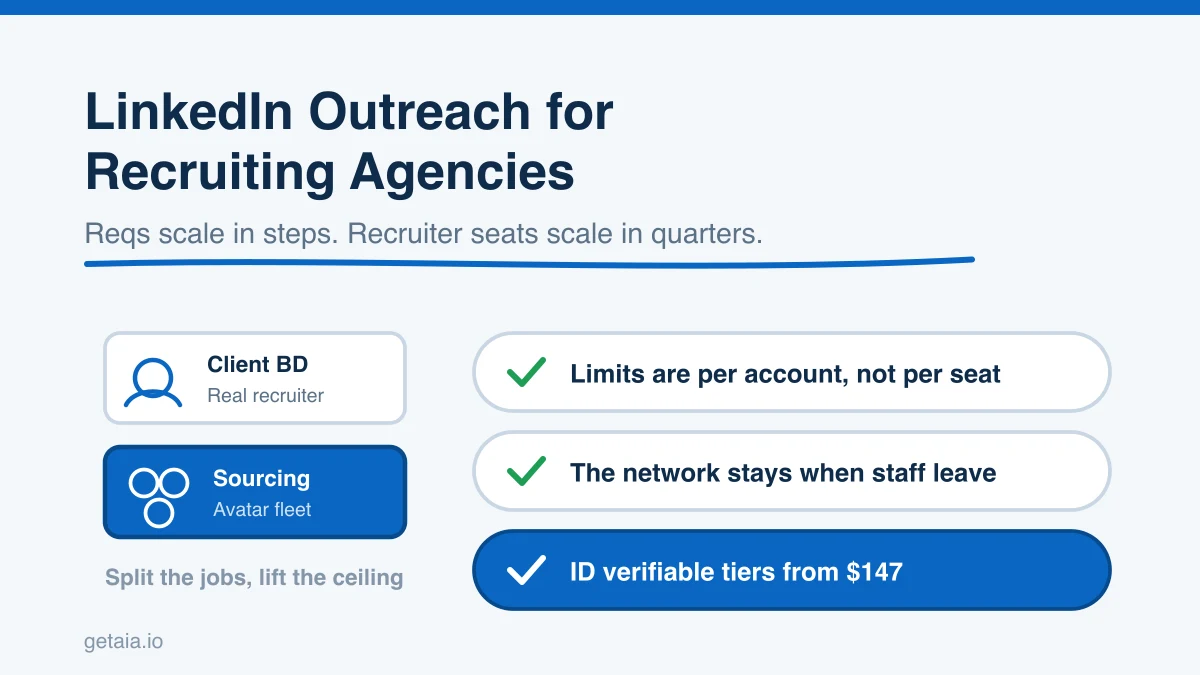
AIA takes a different approach. Instead of renting you access to a stranger’s real profile, AIA provides dedicated prospecting avatars: purpose-built identities that exist to run your outbound, come pre-warmed with 100 or more connections and a posting history, and are pointed at the automation stack you already use. You are not borrowing someone’s account for a month. You are operating an identity layer that belongs to your program.
The tier structure, per avatar per month:
- Gold $147 (ID verified, carries LinkedIn’s verification badge)
- Titanium $197 (ID verified)
- Silver $97
- Platinum $177
- Email avatar $11 per pre-warmed domain per month
Volume discounts stack at 10 percent off for 10 or more avatars, 20 percent off for 50 or more, and 30 percent off for 100 or more. Every avatar carries a 48 hour replacement SLA, and replacements arrive already warmed and connected, not as a cold account you have to nurse for six weeks. You can see the full breakdown on the AIA pricing page.
Rebutting the “Real Beats Synthetic” Narrative Head On
LinkedSDR’s central argument is that real, ID-backed accounts are inherently safer and more legitimate than avatars. Take that claim apart honestly, because parts of it are true and the conclusion still does not follow.
First, AIA has ID-verified accounts too. The idea that only rented real profiles carry ID verification is simply not accurate. AIA’s Gold and Titanium tiers are ID-verified LinkedIn accounts that carry LinkedIn’s own verification badge. If your concern is that a prospect or LinkedIn itself checks for verification, AIA answers that directly at $147. So the “we are verified, they are not” framing collapses the moment you look at the tier list.
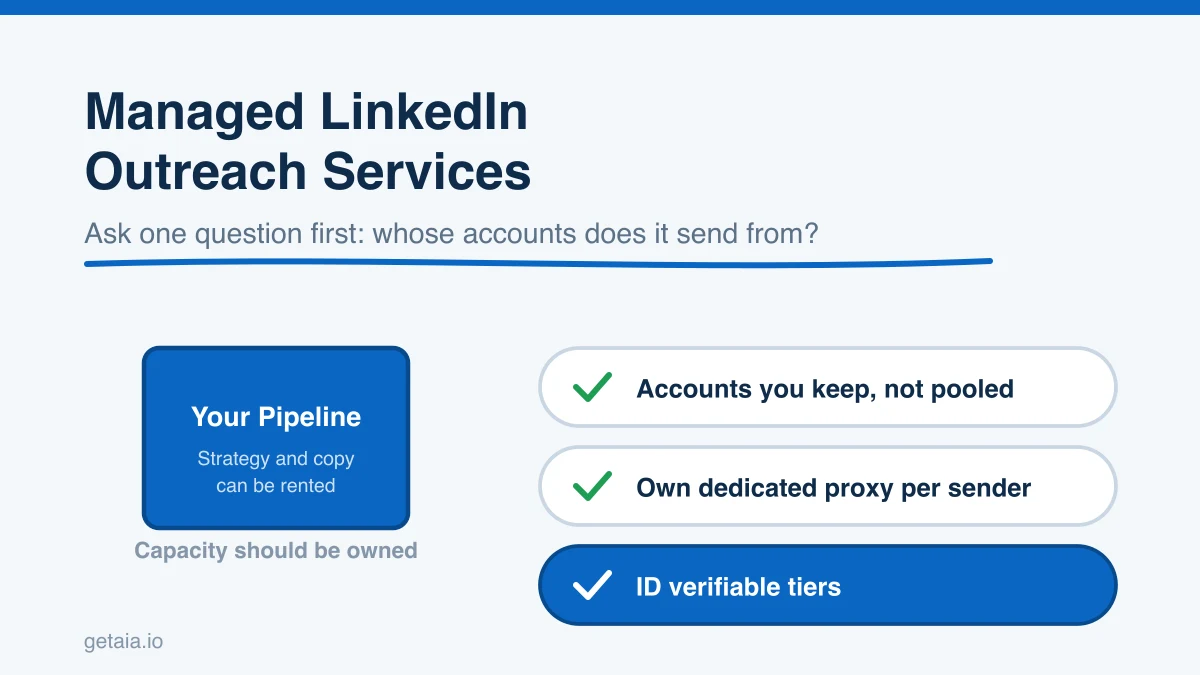
Second, renting a real person’s profile means you do not control it. When you rent an account operated by a real individual, your outreach depends on that person’s identity, their availability, and their behavior across every other client they take on. If that profile gets flagged for the aggregate activity of everyone renting it, you inherit the restriction. You are one tenant in someone else’s account. An AIA avatar is a dedicated identity assigned to your program, warmed for your use, and operated inside your stack.
Third, and this is the honest part, both models operate outside LinkedIn’s single-human-user assumption. A rented real profile running automated outreach for a paying client is not doing what LinkedIn’s terms envision, and neither is an avatar. Anyone who tells you their approach carries zero platform risk is selling you a story. The right question is not “which one is risk free” (neither is) but “which one gives me control, coverage, and a real recovery path when something goes wrong.”
Where LinkedSDR Wins
Give them their due. If your entire outbound motion lives on LinkedIn and nowhere else, if you specifically want a human-operated US profile with a long visible history, and if you are comfortable renting rather than controlling the identity, LinkedSDR is a legitimate option. Their 500-plus connection floor and one year minimum aging are real selling points, and a 48 hour replacement guarantee is a genuine safety net. For a small team that wants three to five profiles and never plans to add channels, it can work.
Where AIA Wins
AIA’s advantage shows up the moment your program needs more than a single channel or more than a handful of accounts.
Multi-channel identity. LinkedSDR sells you a LinkedIn profile and stops there. AIA avatars extend the same identity across LinkedIn, email (pre-warmed domains at $11 per month), and X. A prospect who gets a LinkedIn connection request, then a coherent email from a matching domain, then sees the same name in their X feed is being reached across three reinforcing contexts. That coordinated presence is a moat a single rented profile cannot build. There is more on this in why AIA avatars.
Instant scalability. Recruiting, verifying, and aging real human operators is slow by nature, which is why rental marketplaces gate you behind minimums and availability. AIA avatars are provisioned pre-warmed, so scaling from 10 to 100 is a purchasing decision, not a hiring project. One AIA client, a top-100 US agency, ran 185 avatars to generate 500 or more sales-qualified leads and $2.3 million in net-new revenue in under 90 days. That is the kind of ramp that is hard to hit when every seat depends on onboarding another real person.
Price at the entry point. AIA’s ID-verified Gold tier at $147 sits right in the middle of LinkedSDR’s own range while adding the verification badge and the multi-channel layer. The proprietary AI Silver tier starts at $97 per avatar per month, below LinkedSDR’s cheapest $115 tier, which only unlocks at 50-plus profiles.
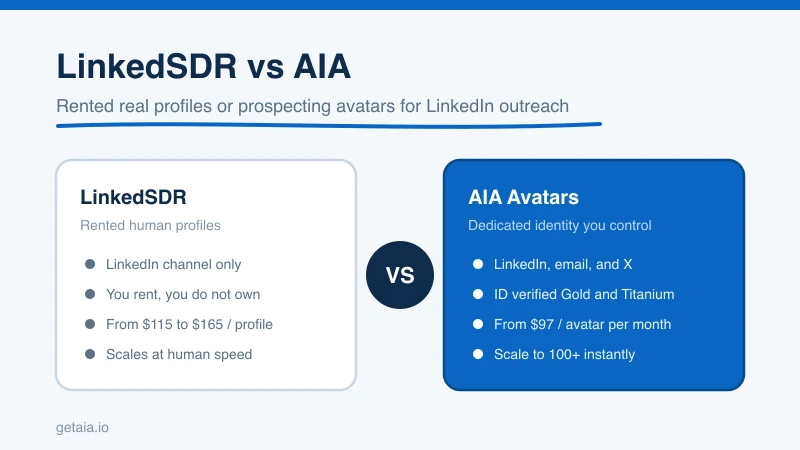
Here is the head to head at a glance:
| LinkedSDR | AIA | |
|---|---|---|
| Model | Rented real human profiles | Dedicated prospecting avatars you control |
| Channels | LinkedIn only | LinkedIn, email, and X |
| Entry price | $165/profile (drops to $115 at 50+) | $147/avatar (Gold, ID verified), $97 (Silver) |
| ID verification | Yes, ID-backed reps | Yes, Gold and Titanium tiers |
| Replacement SLA | 48 hours | 48 hours |
| Volume discounts | Tiered by profile count | 10/20/30% at 10/50/100+ |
| Scaling constraint | Human operator availability | None, avatars are provisioned pre-warmed |
Both Support the Tools You Already Run
One more practical note. LinkedSDR advertises compatibility with tools like HeyReach and Expandi. AIA works cleanly with every major LinkedIn automation tool that supports custom proxies: Expandi, HeyReach, Skylead, We-Connect, Buzz, and LIA. Be careful here, because Dripify, Waalaxy, Zopto, Dux-Soup, and Ulinc do not support custom proxies, which means they cannot be safely paired with any rented or avatar account regardless of provider. If your tool is on that list, no account layer fixes it. See the full compatibility breakdown on AIA integrations.
The Honest Take on Platform Risk
Neither provider can promise you zero restrictions, and you should distrust anyone who does. LinkedIn changes its detection thresholds, and any account running outbound at volume is exposed. What matters is the mitigation. AIA’s answer is the 48 hour replacement SLA plus the ID-verified Gold and Titanium tiers, so when an avatar gets restricted your program does not stall, and the replacement arrives already warm and already connected. LinkedSDR offers the same 48 hour window on their side. The difference is what you are protecting: with AIA you are protecting a dedicated, multi-channel identity you own, not a slice of a shared human profile you are only renting.
How to Choose
Choose LinkedSDR if you want a single-channel, human-operated US LinkedIn profile, you are comfortable renting rather than owning the identity, and you have no plans to run email or X from the same identity.
Choose AIA if you want an identity layer you control, verification when you need it, coordinated outreach across LinkedIn, email, and X, and the ability to scale from a handful of avatars to a hundred without waiting on human onboarding. The fastest way to scope it is to look at how to get started with AIA and map your channels first, then pick the tier that matches your verification and volume needs.
Want a straight answer on which setup fits your outbound before you commit a budget? Message AIA on WhatsApp at https://wa.me/37256084933 or head to getaia.io to place your order and start scaling this week.