GoAccounts vs AIA: Which LinkedIn Account Source Actually Scales Your Outreach?
GoAccounts sells and manages ready-made LinkedIn accounts. AIA supplies pre-warmed AI avatars built for your ICP. Here is the honest comparison on pricing, account quality, replacement SLA, and multi-channel reach for teams running serious outreach volume.
If you are shopping for LinkedIn accounts to power an outbound program, GoAccounts is one of the names you will run into. It sits in the same broad category as renting or buying ready-made profiles: pay for an account, plug it into your automation tool, and start sending. AIA takes a different route. Instead of handing you someone else’s account, it gives you a pre-warmed AI avatar built around your ICP and backed by a replacement guarantee.
This post walks through that comparison honestly. We will cover pricing, account quality, restriction risk, replacement policy, multi-channel reach, and the one factor that decides whether an account source actually helps your team hit quota at volume.
The Core Difference Worth Understanding
GoAccounts, based on what it publishes on its own site, is in the business of supplying LinkedIn accounts you buy or take over. The pitch is straightforward: skip the slow process of building a profile from scratch and get something that already looks established.
The catch is what happens after the handoff. When you buy or take over an account, you inherit its entire history, its existing connections, and its restriction risk. If the account was built for a different persona in a different country, LinkedIn sees a sudden change in behavior, geography, and send pattern. That is exactly the signal its trust model watches for.
AIA avatars are not handed-off accounts. They are purpose-built identities seeded toward your verticals, warmed over time, and assigned a proxy that matches the profile geography. You are not taking over someone else’s footprint. You are starting with a clean, consistent identity designed for the outreach you actually plan to run. See why AIA avatars for how that build process works.
Pricing: What You Actually Pay
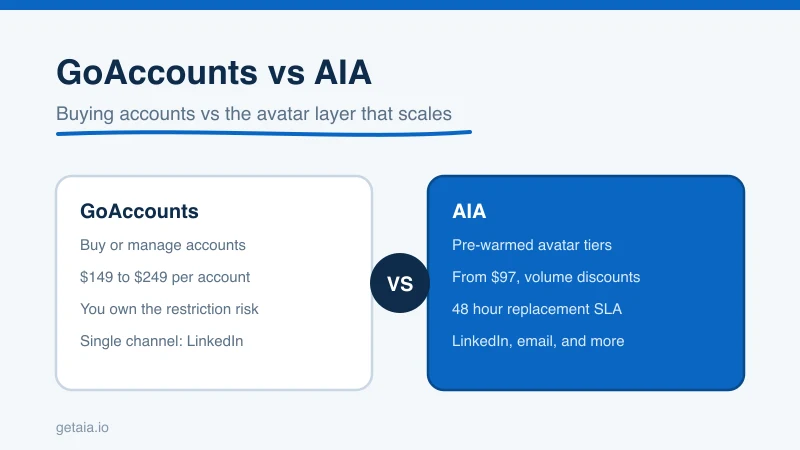
GoAccounts pricing runs roughly $149 to $249 per account, based on what the company publishes on its own site.
AIA’s tiers run, per profile per month:
- Gold $147 (ID verified)
- Titanium $197 (ID verified)
- Silver $97
- Platinum $177
AIA starts lower at the entry tier, and the gap widens once volume enters the picture. Volume discounts kick in at 10 percent off at 10 or more avatars, 20 percent at 50 or more, and 30 percent at 100 or more. If you are running a real outreach program you are not running one or two identities. You are running ten, twenty, fifty. That is where per-unit account pricing stops being the number that matters and fleet economics take over.
You can see the full breakdown on the AIA pricing page.
Account Quality: What “Pre-Warmed” Actually Means
This is where the comparison gets technical. A LinkedIn profile lives or dies on signal, not on who originally created it. A fresh account with no history hits restrictions fast. So does an established account that suddenly changes owner, location, and behavior overnight.
AIA avatars arrive with 100 or more real connections already in place, a posting history, and a profile that reads as active. The platform sees an account that has been behaving like a professional for months, not a new registration or a suspicious handoff that just started firing 50 connection requests a day. That pre-warmed state is what lets you start real outreach volume immediately instead of spending six to eight weeks nursing a profile up to operating speed.
Bought or taken-over accounts come with history too, but it is the history of a different person aimed at a different audience. Every connection in that network was built for someone else’s ICP, not yours. The overlap with your target market is incidental. An AIA avatar built for your use case starts with connections seeded toward the verticals you care about, so the network is working for you from day one.
The ID Verification Question
Buyers increasingly want accounts that carry LinkedIn’s verification badge, and that demand is fair. AIA offers ID verification as a dedicated tier rather than an all-or-nothing default: Gold at $147 per month and Titanium at $197 per month are ID verified LinkedIn accounts that carry the same verification LinkedIn grants users who complete the process.
The advantage is choice. If your use case demands that every profile carry a verification badge, you pick Gold or Titanium. If your volume and economics make Silver or Platinum the right fit, you take that option without paying the ID-verified premium across your entire fleet. When you buy accounts outright, verification status is whatever the individual account happened to come with, and it is not something you control across a batch.
Restriction Risk: Who Owns the Problem
Here is the question that decides whether an outreach program survives its first bad month: when an account gets restricted, who fixes it, and how fast?
When you buy an account, the restriction is your problem. You are out the purchase price, and you are back to sourcing a replacement, warming it, and rebuilding the sequence around it. Every restriction event is dead time and sunk cost.
AIA’s 48-hour replacement SLA is the operational detail that changes this math. When an avatar hits a restriction, you are not negotiating a refund or starting over. You have a replacement identity running within two business days. Across a fleet of dozens of profiles, that guarantee is the difference between a program that keeps producing and one that stalls every time LinkedIn tightens the screws.
Scale: Where the Real Difference Lives
This is the comparison that matters most for teams running serious outreach. Sourcing individual accounts, one purchase at a time, does not scale cleanly. Each account has its own history, its own quirks, and its own failure mode, and you manage them by hand.
AIA is built for fleet-scale deployment. One top-100 US agency ran 185 AIA avatars as a coordinated outbound layer and drove over 500 qualified sales conversations and $2.3M in net-new revenue in under 90 days. That result is not achievable by buying a handful of accounts and hoping they hold. It requires a source that can spin up dozens of operational profiles quickly, guarantee replacement when one hits a restriction, and keep the whole fleet running without per-account babysitting.
Multi-Channel: LinkedIn Is Not Enough
The biggest limitation of buying standalone LinkedIn accounts is that they stop at LinkedIn. The outbound sequences that convert best run the same identity across a LinkedIn connection request, a LinkedIn message, an email, and sometimes a follow-up on another channel. Reaching a prospect from one coordinated identity across multiple surfaces beats reaching them from tools that look unrelated.
AIA pre-warmed email avatars run at $11 per domain, already warmed and ready to pair with the LinkedIn avatar from the same campaign. Your LinkedIn connection request and your email introduction come from the same named person, same company, same context. The prospect sees consistency instead of noise. Learn more about how that multi-channel identity layer fits together at AIA integrations.
Honest Risk Assessment
Both approaches operate in a space where LinkedIn platform risk is real. Any tool or account that runs automated sequences faces the possibility of restriction. You should not trust any provider that claims their approach carries zero risk, because that is simply not true.
What a responsible provider does is minimize that risk through proper warm-up, realistic daily limits, a proxy that matches the account geography, and a fast replacement path when something goes wrong. AIA’s 48-hour SLA and its pre-warmed model are the practical answer: not a promise that restrictions never happen, but a guarantee that your program does not stop when they do.
Which Source Is Right for You
GoAccounts makes sense if you want to own an account outright, you are comfortable inheriting its history, and you are running low volume where scale, replacement SLA, and multi-channel reach are not priorities.
AIA makes sense if:
- You are running ten or more outreach identities
- You want volume discounts that make fleet-scale economics work
- You want ID-verified tiers without paying a premium on every profile
- You need email avatars that pair with LinkedIn identities in the same campaign
- You need a 48-hour replacement SLA so a restriction does not kill your program
If you are serious about LinkedIn outreach at scale, the account layer is the highest-leverage decision you make. Every automation tool in the market, from Expandi to HeyReach to Skylead to We-Connect to Buzz to LIA, runs on top of the accounts you feed it. A weak account layer caps every tool you plug into it. A strong one multiplies the results of every sequence you run.
You can see how to start with AIA or review the tier options at getaia.io to find the right fit for your program volume. When you are ready, place your order and we will get your first avatars provisioned.
If you want to talk through what setup makes sense for your team, reach out on WhatsApp at wa.me/37256084933.