Virtual SDR Teams vs Hiring SDRs: The Real 2026 Cost Breakdown
Hiring an SDR is not the only way to fill your pipeline. Here is the honest cost of an in-house rep versus a virtual SDR team built on avatar accounts, and how to decide which one actually scales.
Every founder and sales leader hits the same wall. Pipeline is thin, so you decide you need more outbound. The default move is to hire a sales development rep, or a whole team of them. But before you post that job, it is worth running the numbers honestly, because the fully loaded cost of an in-house SDR is far higher than the base salary suggests, and there is now a second model that fills the same top of funnel for a fraction of the spend.
This guide breaks down what an SDR actually costs you in 2026, what a virtual SDR team costs instead, and where each one genuinely wins. The goal is not to tell you humans are obsolete. It is to help you decide which mix of the two puts the most qualified conversations on your calendar per dollar.
What an In-House SDR Really Costs
The salary is the number everyone quotes and the smallest part of the real total. When you add everything up, a single SDR in the US typically costs a lot more than the headline figure.
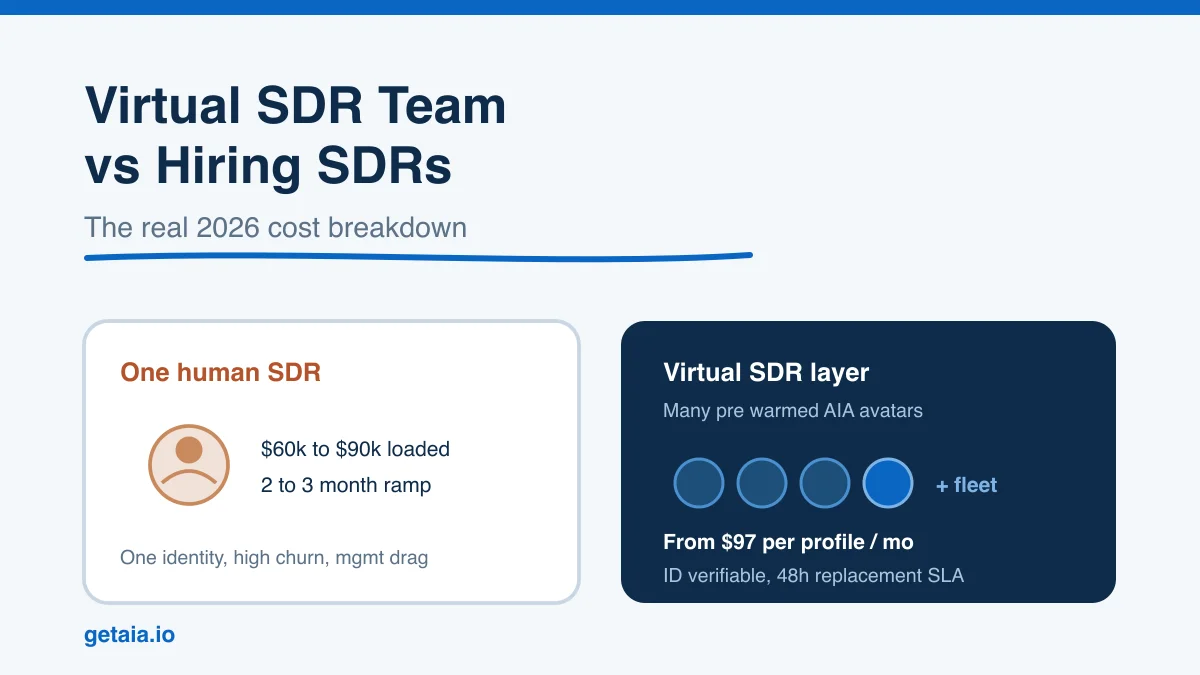
- Base plus commission. A ramped SDR runs roughly $60,000 to $90,000 all in once you include on-target earnings.
- Tools and data. Sales Navigator, an email sequencer, a dialer, and enrichment credits add several hundred dollars per rep per month.
- Management overhead. Someone has to hire, onboard, coach, and manage the rep. That manager’s time is real money.
- Ramp time. A new SDR takes two to three months to become productive. You pay full cost during a stretch when output is a fraction of steady state.
- Churn. SDR turnover is famously high. The average tenure is well under two years, so you often eat the ramp cost again before the rep ever pays back.
Add it up and one productive seat is a five figure quarterly commitment before a single meeting is booked. Scale that to a team of five and you are running a meaningful line item with real management drag attached.
What a Virtual SDR Team Is
A virtual SDR team flips the model. Instead of one human sending from one identity, you run many outreach identities in parallel, each operating inside safe daily limits, coordinated by a small human layer that handles strategy, replies, and booked calls.
The engine underneath is not magic. It is three matched pieces:
- The identity layer. A fleet of outreach accounts, each looking human and each staying inside safe limits so no single profile carries too much load.
- The automation layer. A proxy friendly tool that runs sequenced connection requests and messages across those identities.
- The human layer. One person (or a fractional team) steering targeting, handling live replies, and closing to a booked meeting.
The accounts are where most virtual SDR setups quietly fail. Run ten identities from one data center IP, or spin up fresh zero history profiles, and LinkedIn reads it as exactly what it is. That is why the account layer matters more than the tool. This is the layer AIA is built to be: pre warmed, pre aged avatar accounts that each arrive with 100 or more real connections already in place, so they start with trust instead of the cold signal the platform watches most closely. See why AIA avatars for how that identity supply is built.
The Cost Comparison, Side by Side
Here is where the two models diverge sharply. One human SDR covers one sending identity. A virtual SDR team covers many, at a per identity cost that is a small fraction of a salary.
AIA avatar tiers run per profile per month:
- Gold $147 (ID verified)
- Titanium $197 (ID verified)
- Silver $97
- Platinum $177
Add pre warmed email avatars at $11 per domain when you want to run email alongside LinkedIn. Volume discounts of 10, 20, and 30 percent kick in at 10, 50, and 100 or more avatars, so the more identities you run, the cheaper each one gets. The full breakdown is on the AIA pricing page.
Put that against the SDR math. For roughly what you would spend on the tools and data for one human rep, you can field a handful of outreach identities. For the fully loaded cost of one SDR, you can run a fleet large enough to generate multiples of the touches a single person could ever send by hand, without the ramp, the management drag, or the churn.
The Proof Point
This is not a spreadsheet fantasy. One top 100 US agency ran 185 AIA avatars as a coordinated virtual SDR layer and drove over 500 SQLs and $2.3M in net new revenue in under 90 days. No human team of five could physically send that volume of personalized touches in that window. The identity layer is what let a small human crew punch far above its headcount.
Where Humans Still Win
Be honest about the trade-off, because pretending otherwise gets you burned. A virtual SDR team is unmatched at the top of the funnel: volume, consistency, and reach across many identities. It is not a closer. The moment a prospect replies with real interest, a sharp human should take the conversation. The winning setup is not humans or avatars, it is a small human team steering a large avatar driven sending layer, so your people spend their hours on live conversations instead of grinding out cold first touches.
The Honest Risk, and How to Manage It
Any outreach at scale on LinkedIn carries platform risk, and anyone who tells you otherwise is selling you something. Accounts can get restricted. The question is not whether you can eliminate that risk (you cannot) but whether a single hiccup can stall your whole pipeline.
With a virtual SDR team, it does not, for two reasons. First, load is spread across many identities, so no single restriction takes down more than a sliver of capacity. Second, AIA backs every avatar with a 48 hour replacement SLA, so a restricted account is swapped inside two days and your sending layer keeps running. For the strongest trust signal, the Gold and Titanium tiers are ID verified LinkedIn accounts, which directly answers the tired claim that only a real human profile can be verified.
The Multi-Channel Edge
The other thing a virtual SDR team gives you that a single hire cannot is channel reach from one coordinated identity. The same avatar layer can run LinkedIn and email together (pre warmed email avatars are $11 per domain), so a prospect who ignores a connection request still hears from you where they do read. That multi-channel reach from one identity is the part a lone SDR juggling separate logins can rarely execute cleanly, and it is where a well built virtual team quietly compounds its advantage.
How to Decide
Run the simplest version of the math for your own numbers.
- Total your fully loaded SDR cost. Salary, tools, management time, ramp, and expected churn. Not just base pay.
- Set your target touch volume. How many qualified first touches per week does your pipeline actually need?
- Size an avatar fleet to hit it. Price a virtual SDR layer at the tier and volume that reaches that number. New to this? Start with how to start with AIA.
- Keep the human layer lean. One skilled closer steering the fleet beats five reps sending cold touches by hand.
For most teams the answer is not either or. It is a small human crew on top of a large virtual layer, which gets you more qualified conversations per dollar than hiring alone ever could.
Ready to Build Your Virtual SDR Layer
Skip the ramp, the management drag, and the churn. Field a fleet of pre warmed, ID verifiable AIA avatars that run outreach at scale from day one, backed by a 48 hour replacement SLA and volume discounts as you grow. Start your order at app.getaia.io, or message the AIA team on WhatsApp if you want help sizing your fleet against your current SDR spend first.