12 LinkedIn Connection Request Message Templates That Actually Get Accepted in 2026
Copy-paste LinkedIn connection request templates for cold outreach, recruiter messages, and B2B sales -- plus the exact phrasing mistakes that kill your acceptance rate before the prospect even reads your note.
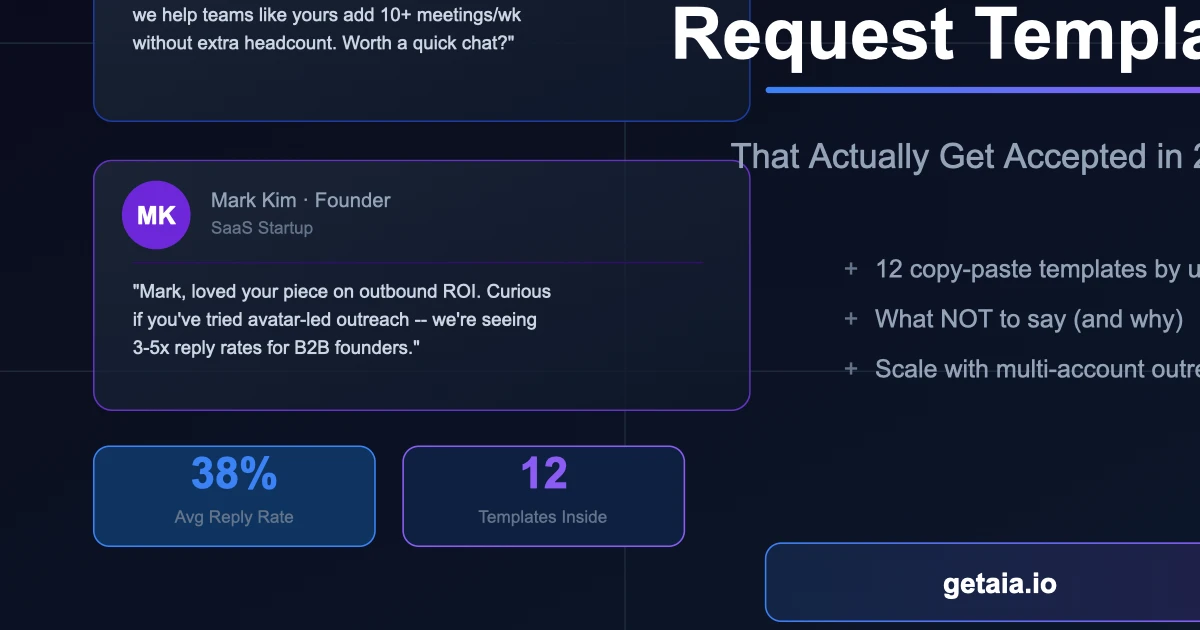
A LinkedIn connection request that converts is not a trick. It is a short, specific sentence that answers one silent question in the prospect’s head: why should I let this stranger into my network?
Most people answer that question poorly. They write something generic, something that sounds like it was drafted for everyone, which means it resonates with no one. A few people write nothing at all and just hit connect. Both approaches leave acceptance rate on the floor.
This guide gives you 12 working templates organized by scenario, explains the structural logic behind each one, and covers the fastest ways to kill your acceptance rate before your prospect even finishes reading the note.
Why the Connection Note Matters More Now Than It Did
LinkedIn’s algorithm has gotten more aggressive about flagging bulk connection behavior. Accounts that send large numbers of requests with no note, or with identical notes, are more likely to trip spam filters and face connection caps. A short, specific note does two things at once: it increases the acceptance rate, and it signals to the platform that you are a real person having a real reason to connect.
That matters even more when you are running outreach at scale across multiple identities. Each account needs to behave like a human with individual reasons for reaching out, not like a broadcast channel pushing the same copy from every profile. That is one reason high-volume teams using AIA avatar accounts pair those accounts with personalized note sequences — the identity layer provides the warm, aged profiles, and the message layer provides the behavioral signal that looks natural to LinkedIn’s filters.
The Structure of a Message That Works
Before the templates, the logic: every effective connection note is built from the same three pieces, though you rarely use all three in a single note.
- The hook — why you are reaching out to this specific person, not a category of people. Something you noticed about them, their company, their content, or their role.
- The value signal — one line that suggests why connecting benefits them, not just you.
- The ask — nothing. A connection request note should not ask for a call, a demo, or a response. The ask comes after they accept.
Keep the total length to two or three sentences. LinkedIn caps connection notes at 300 characters, and notes that use the full 300 often feel like a pitch stuffed into a text box. The sweet spot is 150 to 200 characters: long enough to be specific, short enough to read in a glance.
The 12 Templates
Cold B2B Outreach
1. Shared pain point “Hi [Name], saw you’re scaling outbound at [Company]. We help teams like yours add qualified meetings without growing headcount. Thought it was worth connecting.”
2. Content reference “Hi [Name], your recent post on [topic] was spot on. I work with [role type] on similar challenges. Would love to have you in my network.”
3. Mutual connection “Hi [Name], [Mutual name] mentioned we should connect. I work in [relevant space] and think we’d have a lot to talk about. Happy to connect.”
4. Trigger event “Hi [Name], congrats on the [new role / funding / expansion]. I work with a lot of [role type] at this stage. Thought connecting now made sense.”
5. Direct value “Hi [Name], I help [ICP description] get [specific result]. Saw [specific thing about their profile] and thought you might find what we’re building relevant.”
Recruiter and Talent Outreach
6. Role specific “Hi [Name], I’m hiring a [role] at [Company]. Your background in [specific skill] caught my eye. Would love to connect and share more details if you’re open to it.”
7. Passive candidate “Hi [Name], not sure if you’re actively looking, but we have an opening that matches your [specific skill/experience] closely. Happy to connect and tell you more.”
Founder and Networking Outreach
8. Community tie “Hi [Name], fellow [community/event/group] member here. Love what you’re building at [Company]. Would be great to have you in my network.”
9. Industry insight “Hi [Name], I’ve been following [Company]‘s growth in [space]. I cover this market closely and think we’d have useful things to exchange. Worth connecting.”
10. Warm intro “Hi [Name], [Name] thought we should meet. I’m doing work in [adjacent space] and it sounds like there’s real overlap with what you’re focused on.”
Follow-up After Meeting or Event
11. Post-event “Hi [Name], great meeting you at [Event]. Would have connected sooner but wanted to wait until I could send a proper note. Looking forward to staying in touch.”
12. Post content engagement “Hi [Name], I’ve been following your content on [topic] for a while. Your take on [specific idea] was the clearest I’ve read. Would love to connect.”
What Kills Your Acceptance Rate Before They Finish Reading
Generic openers. “I came across your profile and was impressed” is the dead giveaway of a template. Prospects see through it immediately. Replace any generic opener with something you actually observed: their job title change, a post they wrote, a company milestone, a shared community.
Leading with the ask. Notes that end with “would you be open to a 15-minute call?” before the person has accepted are asking for two things at once. The connection request is the first ask. Keep it to one.
Copying a word-for-word template across all your outreach. Even a good template needs to be rotated and varied. If you are sending 50 requests today, at least three or four versions of the note should be in circulation. LinkedIn pattern-matches on identical text at volume.
No note at all. Blank connection requests convert at roughly half the rate of personalized ones for cold outreach. The people who skip the note are betting on profile strength alone. That bet gets worse as you move further from warm network territory.
Overselling in 300 characters. A connection note is not a pitch. The second you start listing features or dropping a case study link, you’ve made the note about you instead of them. Save the pitch for after they accept and you send the follow-up message.
Scaling Personalized Outreach Without Burning One Account
The disconnect most outreach teams hit is that they know personalization works, but they cannot physically personalize at volume from a single identity. One person sending 20 to 25 connection requests a day — the safe daily limit on a single LinkedIn account — cannot reach the numbers a growing pipeline demands.
The teams that solve this run multiple warm, aged outreach identities in parallel, each sending within safe limits, each with its own variation of the note sequence. The result is total volume that scales while each individual account keeps a natural sending pattern. This is the exact use case AIA avatar accounts are built for: pre-warmed profiles with real connection history already in place, so day one outreach starts with the trust signal the platform looks for rather than the cold spike it flags. The AIA pricing page breaks down per-avatar costs by tier if you want to size a fleet against your current outreach targets.
After the Connection: The Follow-up Sequence
Getting accepted is step one. The note should not try to do more than earn the connection. Once they accept, you have a first-degree connection and the ability to message directly without InMail credits.
A standard follow-up sequence after acceptance:
- Day 1 or 2 after acceptance. A short thank-you message that references what you said in the connection note. One sentence. No pitch.
- Day 4 to 7. A value message. A piece of content, an insight, or a resource relevant to their role. Still no ask.
- Day 10 to 14. The ask. One clear question: are they open to a conversation, a demo, a quick call. Keep it specific about what the call is for and how long it takes.
Teams running this sequence at scale across multiple identities typically see 30 to 40 percent acceptance rates on connection requests with personalized notes, versus 15 to 20 percent for blank requests. Reply rates on the follow-up sequence vary by industry and targeting quality, but 15 to 25 percent on the value message step is achievable with a well-warmed account and relevant copy.
The Template Is the Starting Point, Not the End
These twelve templates will outperform a blank connection request immediately. But the real lift comes from treating each one as a skeleton you fill in with something specific to the person you are reaching out to. Swap the generic role type for their actual title. Replace the placeholder topic with the real post they wrote. Change the community name to the real event you both attended.
That specificity is what separates a 20 percent acceptance rate from a 40 percent one. The template gets you off a blank page. The personalization gets you the reply.
If you are ready to move from one account to a fleet, start with the AIA avatar tiers and a sending cadence matched to your pipeline targets. Volume without identity risk is how the teams running the highest outreach numbers are building it in 2026.