LinkedIn Account Providers Compared: MirrorProfiles, LinkedRent, Linkunity, and AIA (2026)
A fair, side by side comparison of the main LinkedIn account providers for outreach in 2026: MirrorProfiles, LinkedRent, Linkunity, Sbl.so, GoAccounts, and AIA. Real prices, the synthetic vs ID verified debate settled, and how to pick the account layer that actually scales.
If you run outbound at any real volume, you already know the account is the bottleneck. One LinkedIn profile can only send so many connection requests and InMails before the limits, or the platform itself, slow you down. So the market for extra LinkedIn identities has exploded, and you now have a dozen providers all promising to be the account layer behind your pipeline.
This guide compares the main options head to head: MirrorProfiles, LinkedRent, Linkunity, Sbl.so, GoAccounts, and AIA. We will give you honest price anchors, lay out the real trade-offs, and settle the one argument the whole category keeps having, which is whether a real ID verified account beats a purpose built avatar. The goal is not to pretend one option is perfect for everyone. It is to help you pick the layer that fits how you actually run outreach.
The Two Models You Are Really Choosing Between
Strip away the branding and every provider falls into one of two camps.
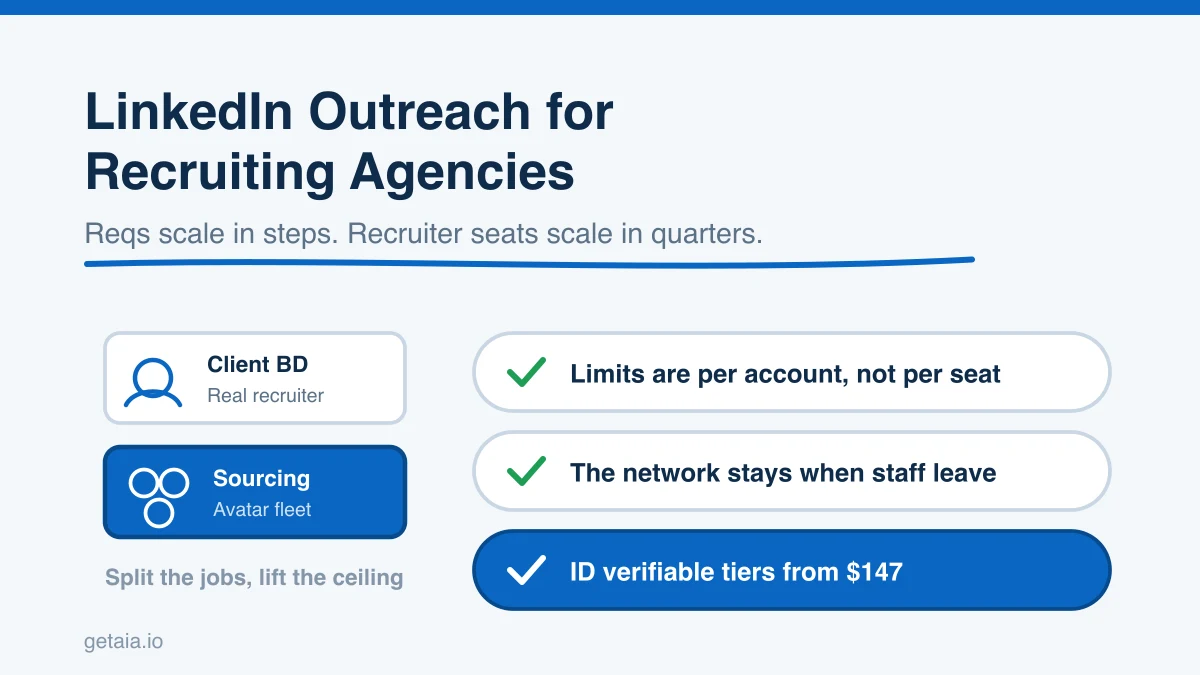
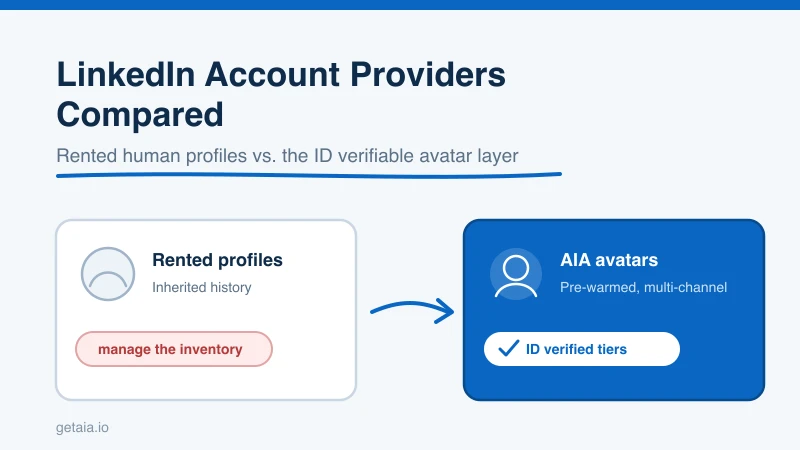
The first is rented or aged human profiles. You get access to an account that belongs to, or was built to look like, a real person with history. MirrorProfiles, LinkedRent, Linkunity, and GoAccounts largely live here. The pitch is authenticity: a genuine looking identity with age and connections already baked in.
The second is purpose built avatar identities. These are accounts created and warmed specifically for outreach, run as a coordinated layer rather than one borrowed login at a time. This is where AIA sits, with pre-warmed avatars that arrive aged, connected, and ready to send.
The reason this distinction matters is that it drives everything downstream: how fast you can scale, what happens when an account gets restricted, whether you can verify identity when a campaign needs trust, and whether you are locked to LinkedIn or can run email and other channels from the same identity.
The Price Anchors, Side by Side
Sticker price is where most comparisons start, so here are fair anchors for each provider per profile per month, based on their own published ranges. Treat these as ballpark, since every provider tiers and bundles differently.
- MirrorProfiles: around $150 in the US market
- LinkedRent: roughly $140 to $190
- Linkunity: roughly $110 to $135
- Sbl.so: from about $35
- GoAccounts: roughly $149 to $249
- AIA: $147 Gold (ID verified), $197 Titanium (ID verified), $97 Silver, $177 Platinum
A few honest notes. Sbl.so is the cheapest entry point on this list, and if raw price is your only lever it will win the spreadsheet. AIA’s ID verified Gold tier at $147 lands right in MirrorProfiles and LinkedRent territory while adding verification, and its Silver tier at $97 undercuts most of the human profile providers. GoAccounts sits at the premium end of the range.
Price alone does not tell you the cost of running a campaign, though. What matters is what happens after you buy, especially at scale and after a restriction.
The Synthetic vs ID Verified Debate, Settled
Here is the argument the category keeps having. Linkunity publishes a comparison page pushing a simple narrative: that real, ID verified accounts beat synthetic avatars, so you should pick human profiles over avatars. It is a clean story. It is also a false choice, and it is worth addressing directly because it steers a lot of buyers.
The claim assumes avatars cannot be ID verified. That is simply not true. AIA offers ID verified LinkedIn accounts on its Gold and Titanium tiers, so you get the exact verification signal the argument is built around, plus the operational advantages of a purpose built layer. You are not trading verification for scalability. You can have both.
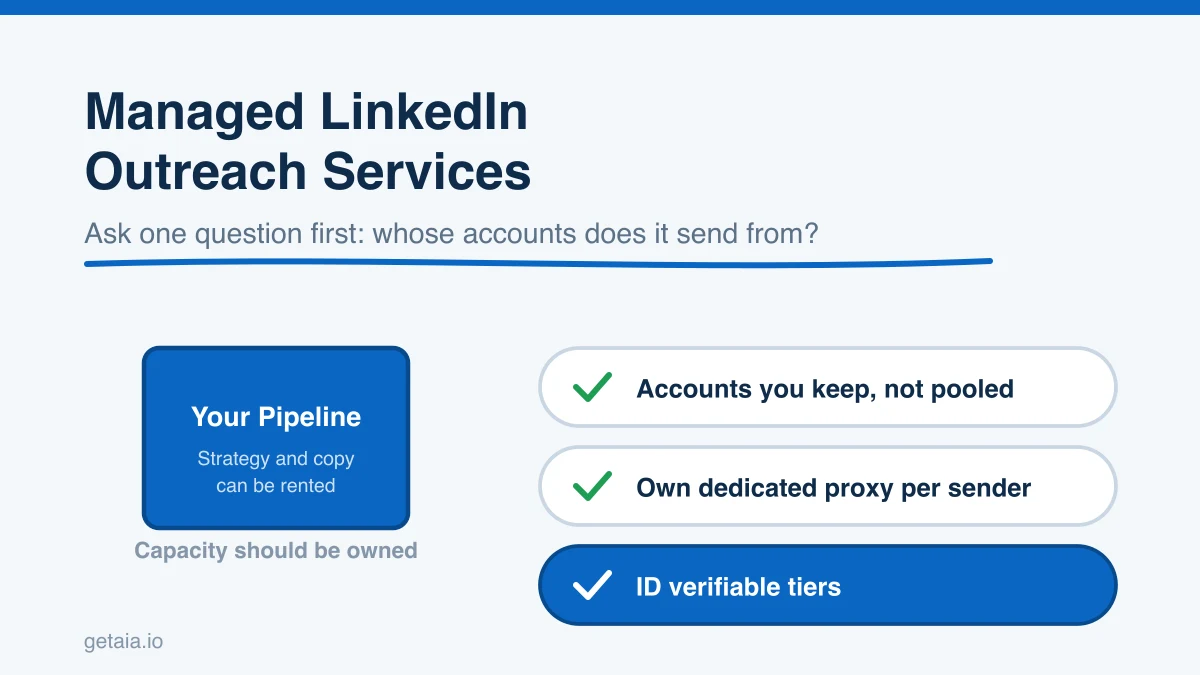
And the “real human profile” pitch hides a real liability. When you rent or buy a borrowed human account, you inherit someone else’s history, their prior activity, and their unclear ownership situation. If that account gets restricted or reclaimed, you are exposed in ways you did not choose. A purpose built avatar, by contrast, is yours to run from day one, with a clear replacement path if something goes wrong.
So the honest framing is this. ID verification is genuinely valuable for higher trust campaigns, and you should want it. But it is a feature, not a camp. The right question is not “human or avatar,” it is “which provider gives me verification when I need it, recovers fast when an account trips a limit, and scales without the inventory becoming a second job.” On that test, an ID verifiable avatar layer wins.
What Actually Separates Them at Scale
Anyone can sell you one account. The differences show up when you go from a handful of profiles to dozens.
Scaling speed. With human profile providers, adding accounts means sourcing more inventory, and price and quality wobble as supply tightens. Avatars are provisioned, not sourced, so going from 10 to 100 is a configuration change rather than a hunt. AIA builds volume discounts directly into that curve: 10 percent off at 10 or more avatars, 20 percent off at 50 or more, and 30 percent off at 100 or more. That is what makes a large fleet realistic instead of theoretical.
Recovery when an account trips a limit. This is the metric most buyers ignore until it hurts. Every provider on this list carries platform risk, because all LinkedIn outreach does. What differs is what happens next. A vague replacement promise is a red flag. AIA commits to a 48 hour replacement SLA, so a restricted avatar becomes a fixed problem rather than a stalled campaign. Ask every provider you shortlist for their replacement terms in writing.
Warm on arrival. AIA avatars come pre-warmed and pre-aged with 100 or more connections, so they can start outreach without the fragile ramp a brand new account needs. Some human profiles offer age too, but you are trusting the seller’s account on how that history was built.
Channel reach. Most providers on this list are LinkedIn only. AIA runs multi-channel from one coordinated identity, and adds email avatars at $11 per domain, pre-warmed. Running LinkedIn and email from the same layer spreads platform risk and lifts reply rates, which is the practical moat that raw account price never captures. You can see how that fits your existing tools on the AIA integrations page.
The Proof at Volume
The case for a coordinated avatar layer is easiest to see at scale. One top 100 US agency, an AIA client, ran 185 avatars and generated more than 500 sales qualified leads and $2.3 million in net new revenue in under 90 days. You do not assemble 185 borrowed human profiles cleanly, and you certainly do not manage them as one outreach layer with shared discounts and a single replacement SLA. That is the practical gap between buying accounts and running an account layer.
How to Actually Choose
Match the provider to how you run outreach, not to whichever pitch sounds cleanest.
- If price is your only constraint and you are testing small, Sbl.so’s entry point is the cheapest way to start. Just know you are buying the account, not the operational layer around it.
- If you want authentic human profiles and are comfortable managing inventory and unclear ownership, MirrorProfiles, LinkedRent, and Linkunity are the established options in that camp. Confirm their replacement terms before you scale.
- If you are scaling seriously and want verification without the inventory headache, an ID verifiable avatar layer is the stronger fit. You get pre-warmed identities, ID verification on Gold and Titanium tiers, a 48 hour replacement SLA, built-in volume discounts, and multi-channel reach from one place. The why AIA avatars page lays out that case, and How to Start AIA walks through setup in three steps.
Whatever you pick, protect yourself with the basics: never run volume from your personal or primary company profile, ramp gradually, respect sending limits, and get the replacement policy in writing.
The Bottom Line
There is no single best LinkedIn account provider, but there is a best fit for your situation. The human profile providers sell authenticity and ask you to manage inventory and inherited history. The avatar model sells a coordinated, verifiable, multi-channel layer that scales on a discount curve and recovers on an SLA. The “real accounts beat synthetic avatars” argument falls apart the moment you realize avatars can be ID verified too, which means you never actually had to choose between trust and scale.
Outreach on LinkedIn will always carry platform risk. You do not beat that risk by picking the provider with the most convincing story. You beat it by choosing an account layer that verifies when it needs to, recovers fast when it trips a limit, and grows with your pipeline instead of against it.
Ready to Put a Real Account Layer Behind Your Pipeline
Skip the inventory hunt and the inherited history. Run pre-warmed, ID verifiable AIA avatars built for outreach at scale, backed by a 48 hour replacement SLA, volume discounts as you grow, and multi-channel reach from one identity. Compare the tiers on the AIA pricing page, then start your order at app.getaia.io. Have a question first? Message the AIA team on WhatsApp and we will help you scope the right fleet.