How to Warm Up a New LinkedIn Account: A Safe 2026 Ramp Schedule
A brand new LinkedIn account is the easiest one to get restricted. Here is a week-by-week warm-up schedule that builds trust with LinkedIn before you ever send a cold connection request at scale.
The fastest way to lose a LinkedIn account is to treat a brand new one like a seasoned one. A profile created yesterday has no history, no trust signal, and no activity pattern that looks human. So when it fires off fifty connection requests on day two, LinkedIn’s automated systems do exactly what they are designed to do: they flag it, throttle it, and often restrict it before a single reply ever lands.
Warming up an account is the unglamorous work that decides whether your outreach ever gets off the ground. This guide walks through a week-by-week ramp that mirrors how a real professional behaves, so your account earns the headroom to actually run campaigns.
Why Warm-Up Matters More Than Ever
LinkedIn has spent the last few years tightening the rules around new and automated accounts. The platform now leans heavily on behavioral signals — how fast you act, how complete your profile is, how much your activity looks like a person versus a script. A cold account has none of the trust that softens those checks.
The core idea is simple. LinkedIn assigns every account an implicit reputation. New accounts start near zero. Every genuine action — a completed profile field, a real like, a slow and steady stream of connections that get accepted — nudges that reputation up. Every suspicious burst nudges it down. Warm-up is the deliberate process of banking trust before you spend it.
Before You Send Anything: Foundation Week
Do not send a single connection request in your first week. This week is entirely about making the account look established.
- Complete the profile fully. Profile photo, banner, headline, about section, at least two experience entries, education, and a handful of skills. An empty profile is the single biggest red flag for a new account.
- Set a real, consistent identity. The name, photo, and history should be coherent. Mismatched details are exactly what review systems look for.
- Log in like a human. Sign in from one stable location and device. Bouncing across IP addresses on a fresh account looks like account sharing or automation.
- Browse, do not act. Scroll the feed, read a few posts, view a handful of profiles in your target niche. You are teaching the account what normal looks like.
By the end of foundation week the account should look like a real person who just has not gotten around to networking yet.
Week One: Light, Human Activity
Now you start acting, but gently. The goal is a trickle of genuine engagement, not outreach.
- Like three to five posts a day from people in your industry.
- Leave one or two thoughtful comments across the week.
- Send two to five connection requests per day — and only to people you have a real reason to connect with, ideally with a short personal note.
- Accept incoming requests and respond to any messages like a person would.
Keep total daily actions low and spread them across the day rather than firing them all in one session. A human does not send twenty requests in ninety seconds, and neither should your account.
Week Two: Building Momentum
If week one produced healthy acceptance rates and no warnings, you can start to scale.
- Raise connection requests to roughly ten to fifteen per day, still with notes and still targeted.
- Keep engaging — likes and comments signal that the account is a participant, not just a broadcaster.
- Watch your acceptance rate closely. A high acceptance rate tells LinkedIn your requests are welcome. A low one, with lots of ignored or withdrawn requests, drags your reputation down fast.
- Publish or reshare one piece of relevant content. Contributing to the feed is a strong trust signal that pure outreach accounts never send.
Weeks Three and Four: Approaching Full Speed
By the third and fourth week a healthy account can move toward its steady-state volume.
- Push connection requests toward the low twenties per day if acceptance stays strong, but never sprint to the limit.
- Introduce your real outreach messaging now that the account has a track record behind it.
- Continue the background engagement. The accounts that survive long term never stop looking active and human, even once they are running full campaigns.
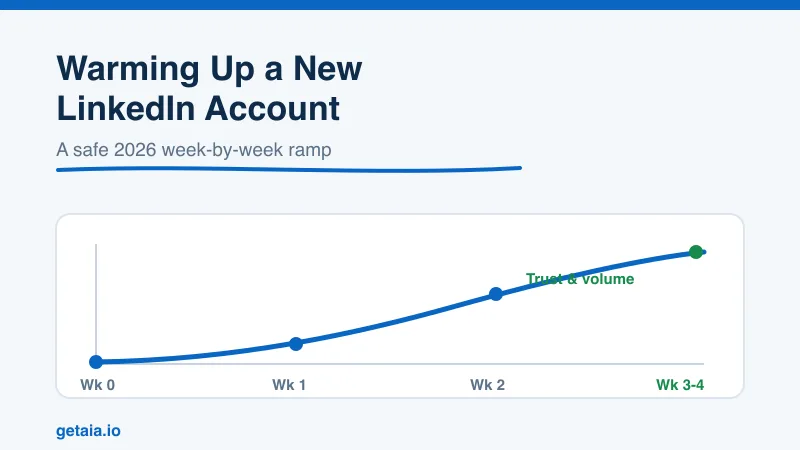
Think of the whole month as a curve, not a switch. Every week you are proving to LinkedIn that this account behaves like a person, so that when you finally run outreach at volume, the platform has no reason to hit the brakes.
Signals That You Are Ramping Too Fast
Back off immediately if you see any of these:
- A jump in connection requests that sit pending and never get accepted.
- Warning prompts asking you to confirm you know someone, or temporary limits on inviting people.
- Any request to verify your identity or a sudden logout.
These are the early tremors before a restriction. When they appear, cut your daily volume in half, lean back into genuine engagement, and give the account several quiet days before pushing again.
Where This Gets Hard at Scale
Warming up one account by hand is tedious but doable. Warming up ten, or running outreach across a whole team of accounts, is a different problem entirely. Each account needs its own consistent environment, its own gradual ramp, and its own human-looking pattern of activity — and doing that manually across a fleet is where most outbound programs quietly break.
This is exactly the operational load AIA is built to carry. Instead of babysitting warm-up schedules and account hygiene by hand, you run outreach on properly maintained avatar accounts that are warmed and operated to look and behave like real professionals, so your pipeline scales without your accounts getting torched. If manual warm-up is the ceiling on your outbound, that is the constraint worth removing.
The Takeaway
A new LinkedIn account is a trust-building project before it is an outreach channel. Spend the first week making it look real, ramp your activity in deliberate weekly steps, watch your acceptance rate like a hawk, and slow down the moment LinkedIn pushes back. Do that, and by the end of a month you have an account with the headroom to actually work. Skip it, and you are just minting accounts for the restriction queue.